Tidra · Brand, Data & Product Design for a Coastal Restoration Company
Branding nature as infrastructure: a B2B identity, data system and product suite for a company that grows coastlines.
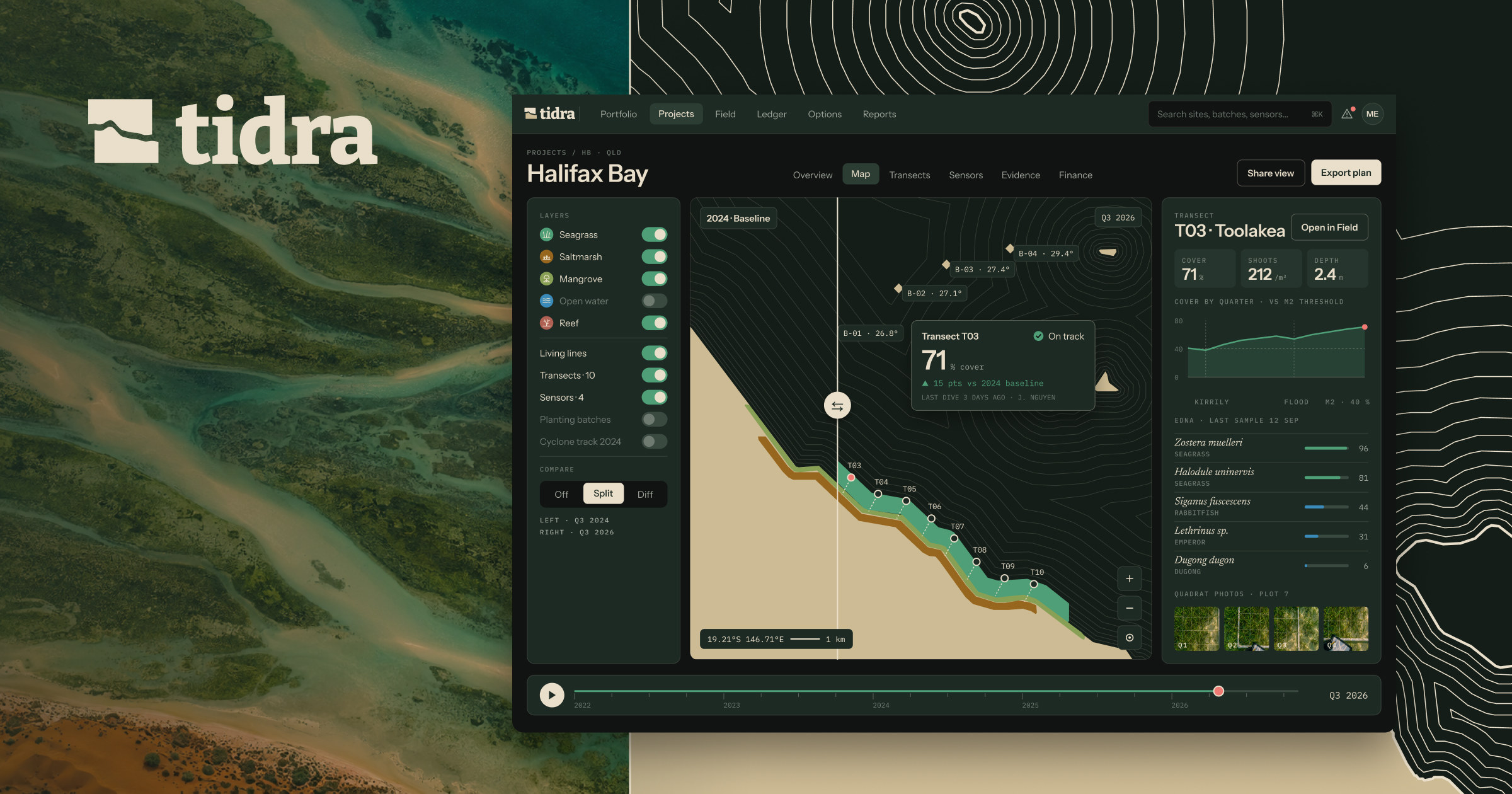
Tidra needed a brand that a council, a dive crew and an investor would all trust: as solid as an engineering firm, as exact as a lab, and nothing like an environmental charity.
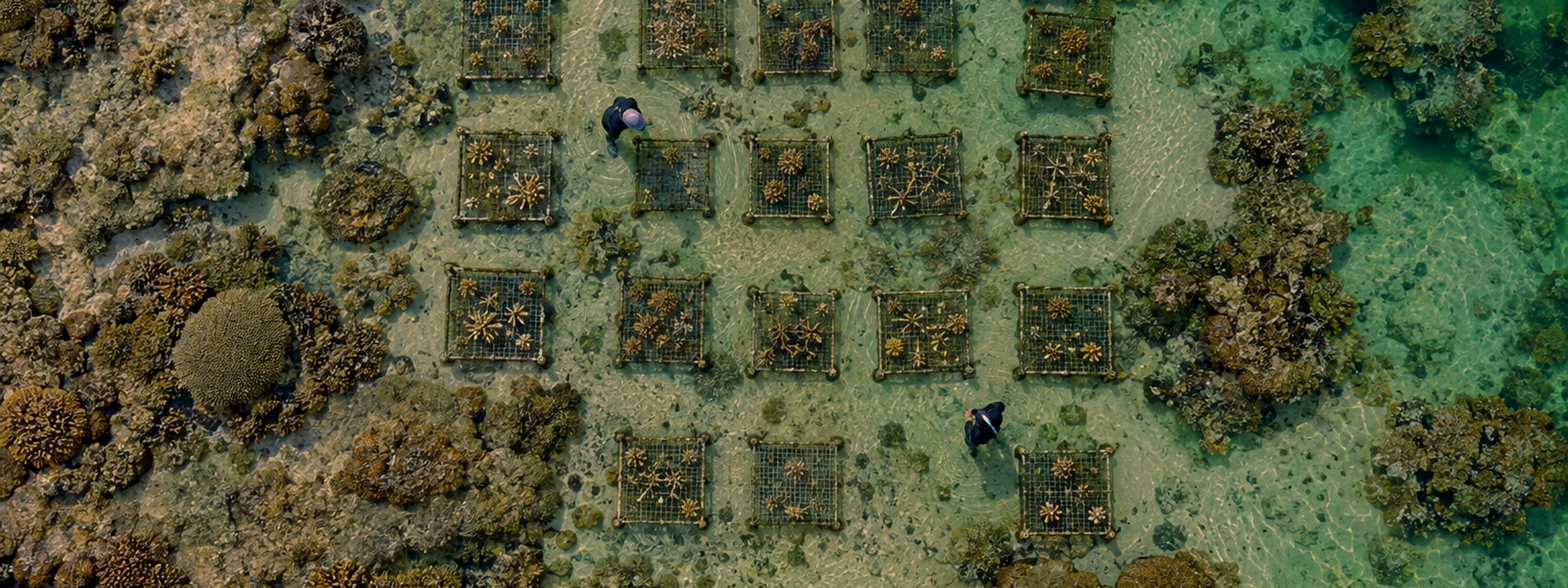
Tidra restores the reefs, seagrass, mangroves and saltmarsh that protect Australia's coast.
It began with a few marine scientists and a borrowed boat in North Queensland. Today it runs its own field crews, nurseries and data team across Queensland, the Northern Territory and Western Australia, working for councils, ports, insurers and public funds.
Before the first seawall was poured, the coast had built its own. Reefs broke the waves. Seagrass held the sand. Mangroves and saltmarsh took the floods. It was the oldest infrastructure in Australia, and it never sent an invoice.
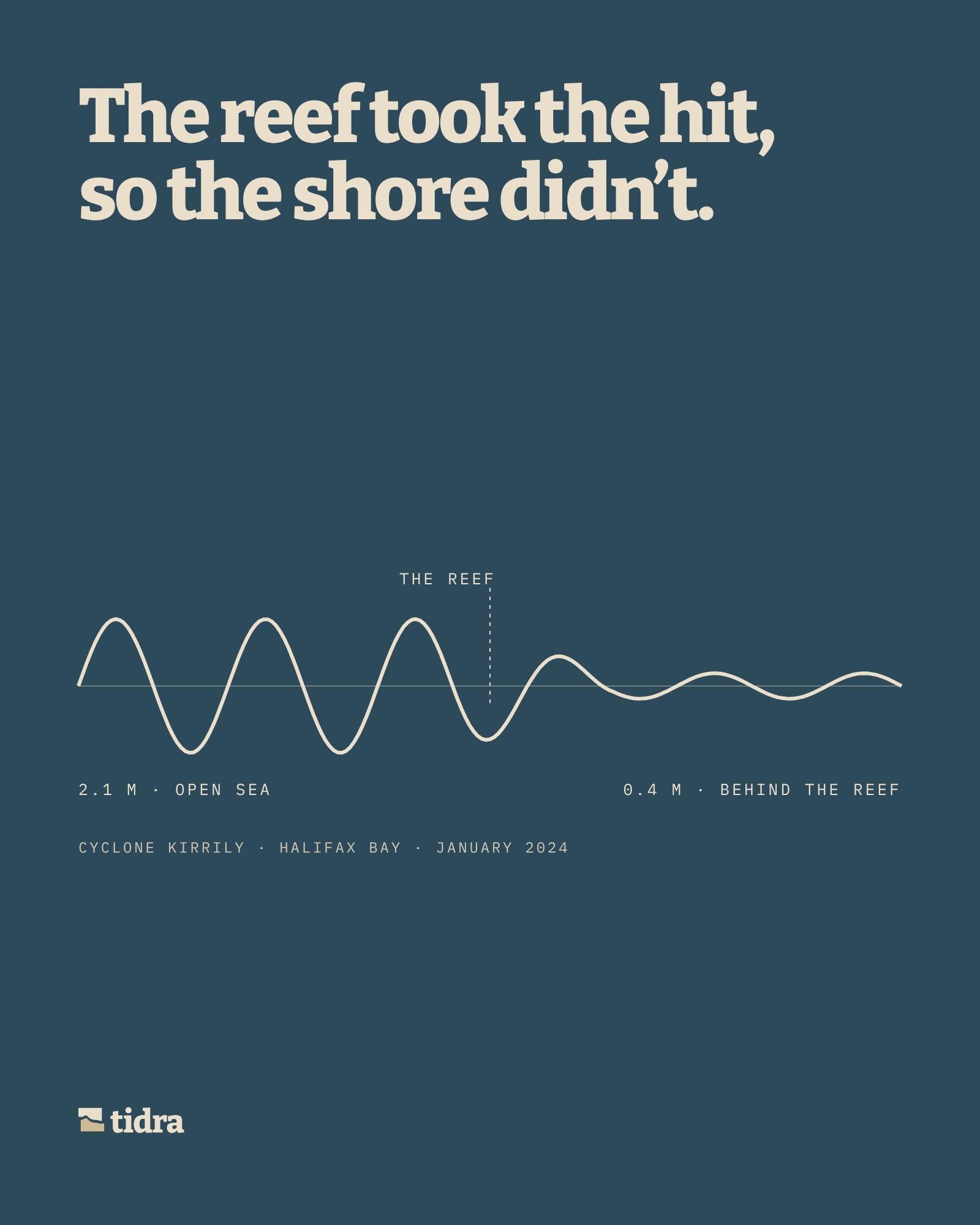
Now it is losing ground. Marine heatwaves bleach the reefs, stronger cyclones tear up the seagrass, and walls and drains cut wetlands off from the tide. When the living edge goes, the waves reach the towns, and the bill moves to concrete.
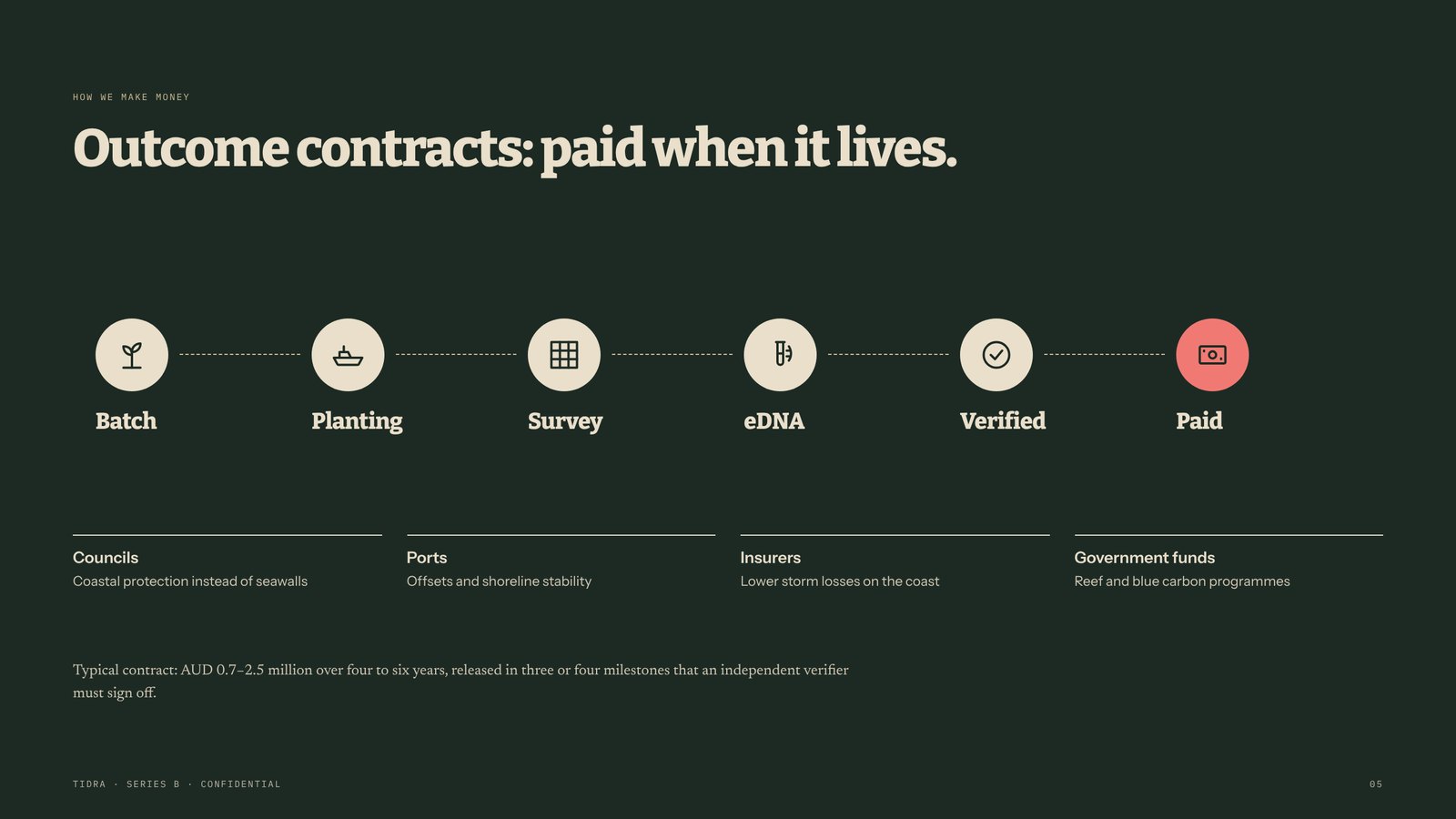
Tidra builds living shorelines the way a contractor builds a road: on a schedule, on a budget, and paid on results.
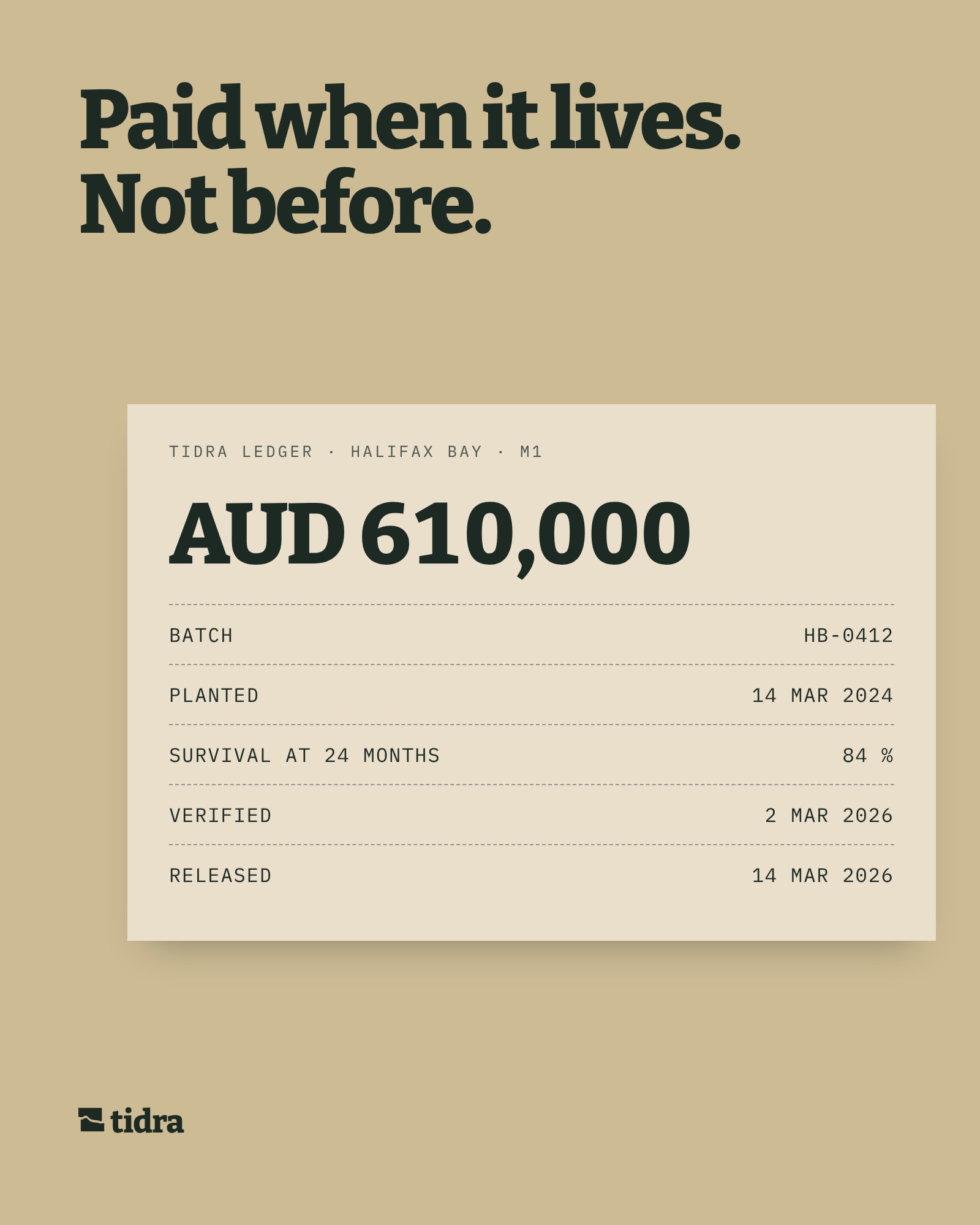
Every contract is split into milestones, and an independent verifier signs each one off. Every site is measured season after season. If a milestone isn't met, the client doesn't pay, and Tidra fixes it at its own cost.
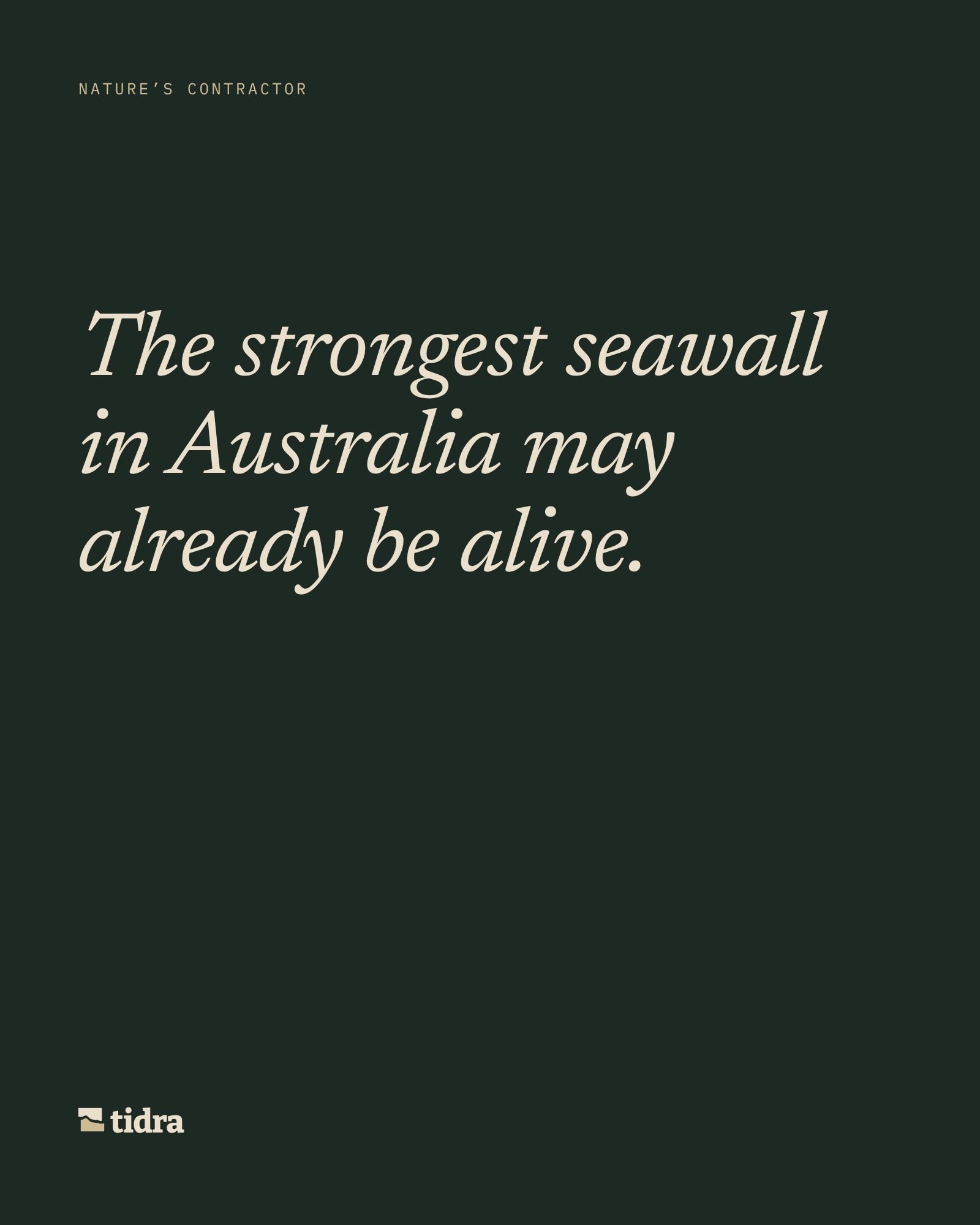
Nature's contractor.
Tidra is positioned as a contractor, not a cause: it sells a result, on a schedule, and proves it. The brand builds like an engineering firm, measures like a lab and never sounds like a charity. Five lines carry the idea, each for a different moment.
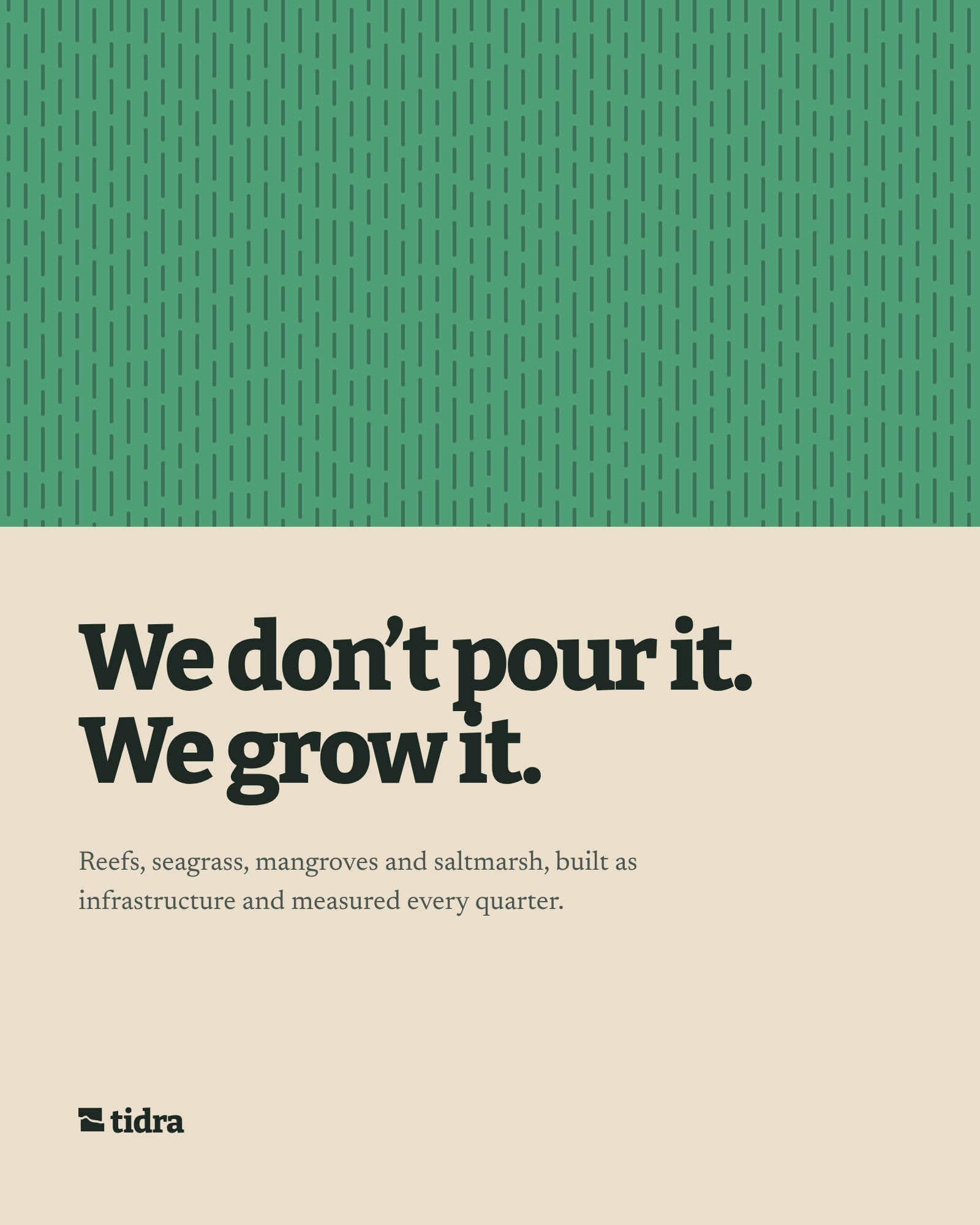
We don't pour it. We grow it.
The cut is the coast.
The symbol is a block cut by a real coastline: 43 km of shore between Halifax Bay and Townsville, where Tidra started. Flattened and read in mirror, the shore becomes the cut, so every Tidra mark carries a piece of real coast.

An engineer in love with the sea.
The confidence of a builder: dates, budgets, delivery.
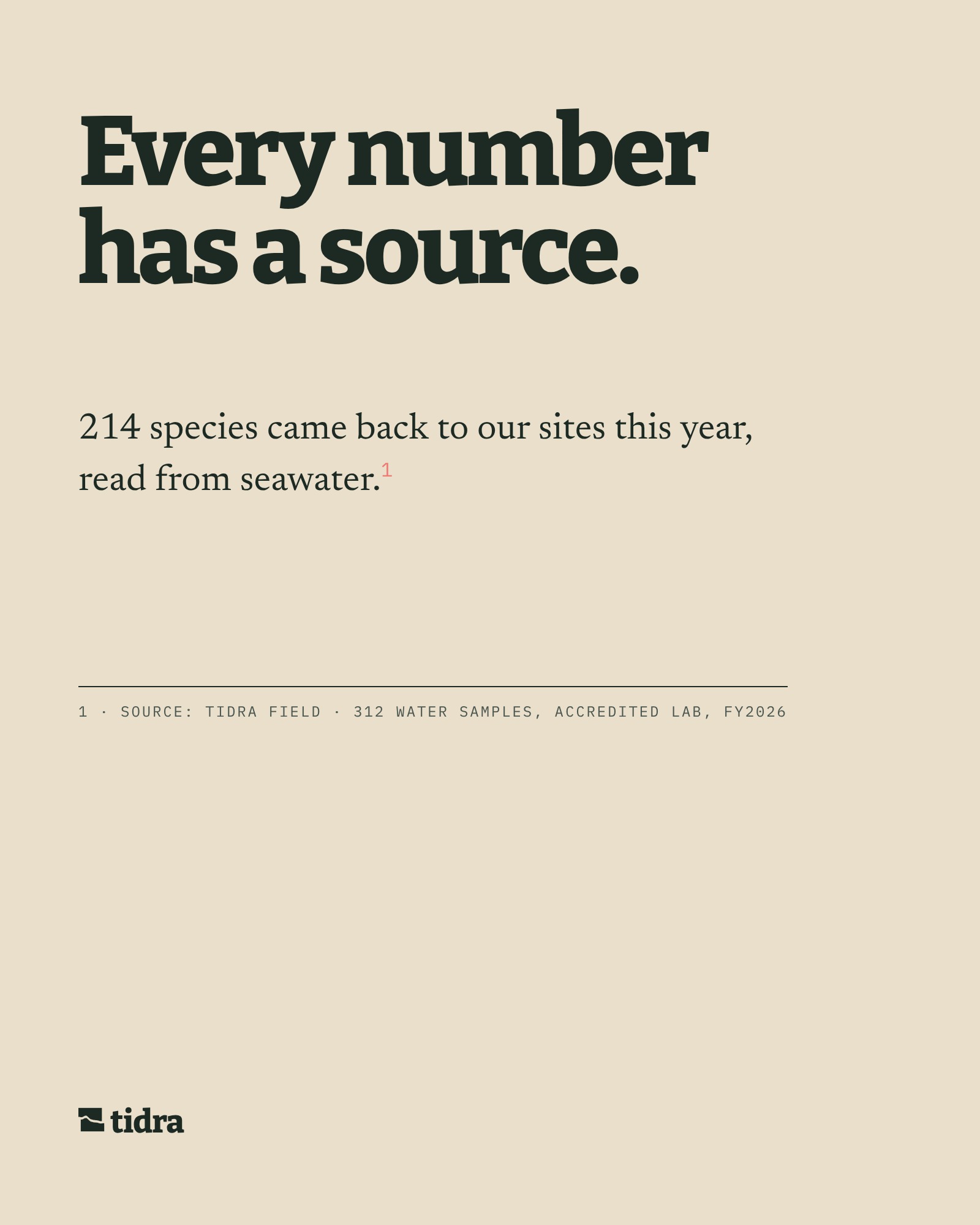
The rigour of a scientist: every number with its proof.
The care of someone who lives on that coast.
Build, lay, anchor, grow, repair, deliver.
Places with names: Halifax Bay, not "the ocean".
A number, always with its source.
Short sentences. Dry humour is allowed.
Save the planet. Pristine. Journey. Guardians.
Sad-turtle stories.
Emojis.
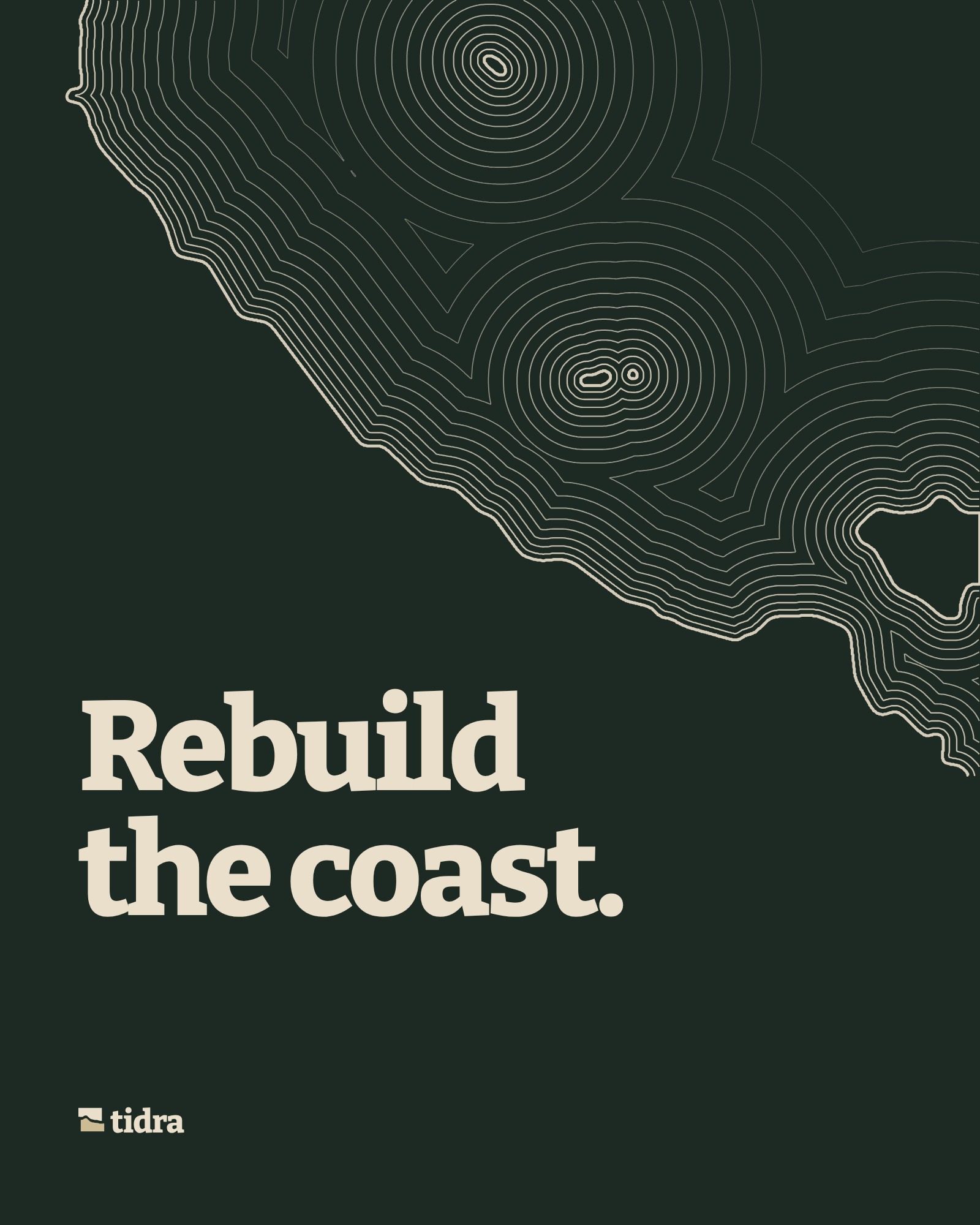
One real coastline, turned into rules.
Tidra's identity is drawn from data, not from a mood board. One real coastline gives the mark its cut, and the same rule redraws every coast the company works on. Colour, type, icons, layout, charts, maps and the apps follow from there, and every rule is written down, so a council officer, an agency or an AI can make Tidra without asking.
01 · The logo
One mark in four versions: the full signature for everyday use, a stacked version for square formats, the symbol alone where space is tight, and the name cut by the coast for large surfaces. Each one works in positive and in negative.
Web, documents, letterhead.
Square formats, profiles, site hoardings.
Icons, favicons, stamps.
Large surfaces. Never next to the symbol.
#1D2A24 on #E9DFCA · main
#E9DFCA, #CDBB94 on #1D2A24
#1D2A24, #2C4A5A on #E9DFCA
#E9DFCA on #1D2A24 · one colour
Lowercase in the logo · "Tidra" in running text
Ink, cream or sand only
The logo is always lowercase. In a sentence, Tidra is a name like any other.
02 · Construction & use
How the mark is built and how it behaves: its measures, how small it can go, the space around it and how the coast carries on beyond it. The top piece reaches left, the bottom piece reaches right, and the cut always stays open.
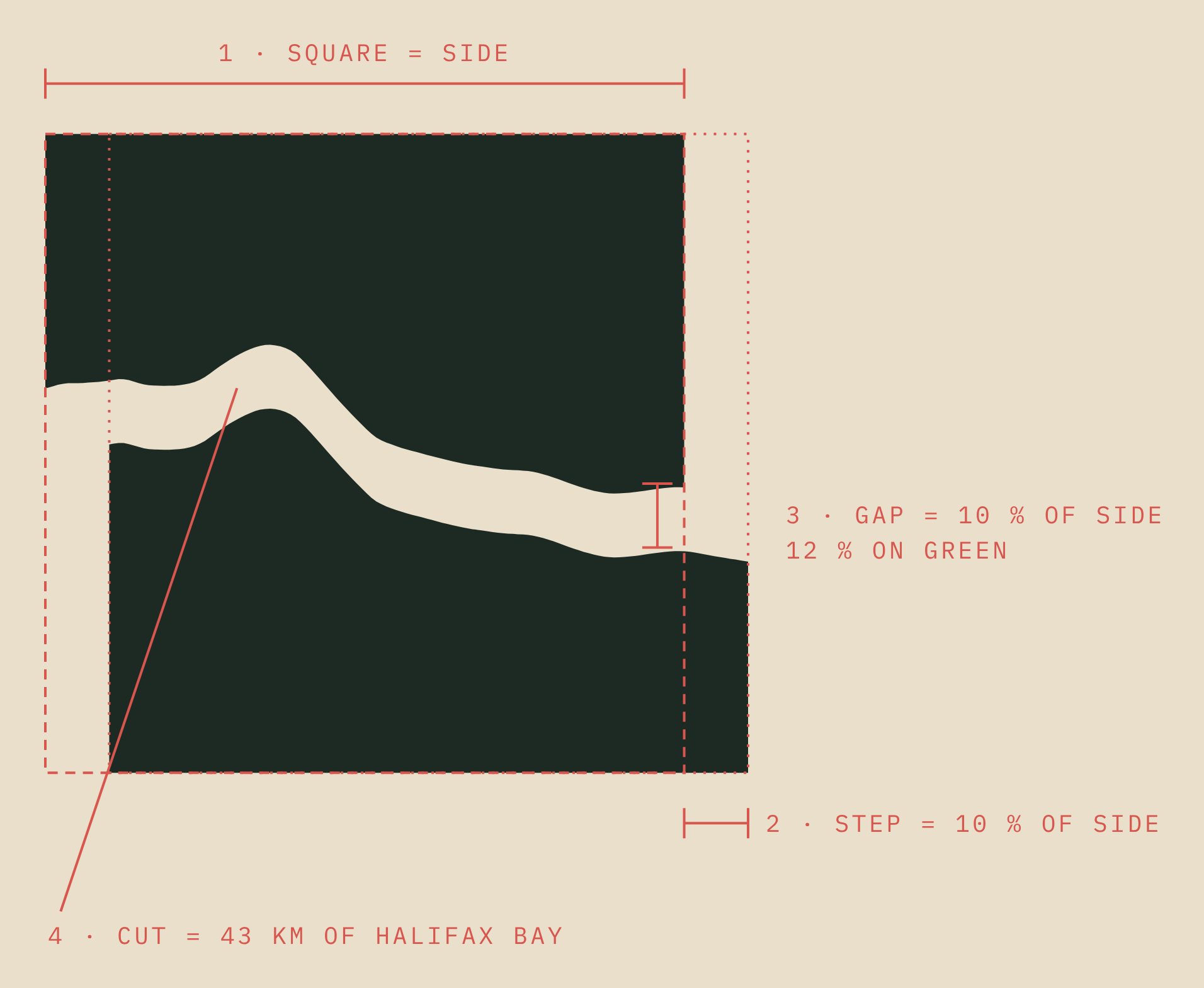
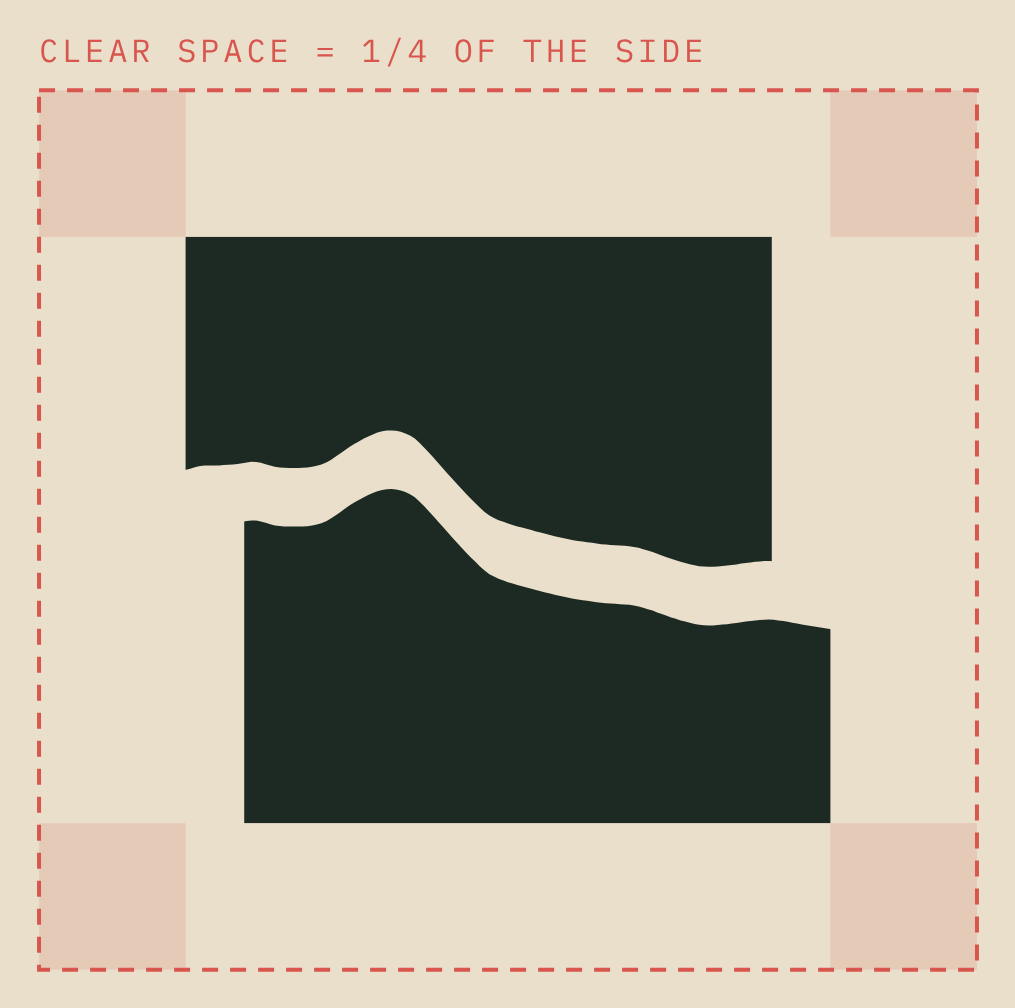
The cut is always open. If it closes, it stops being a coast. Nothing enters the clear space.

03 · Living lines & maps
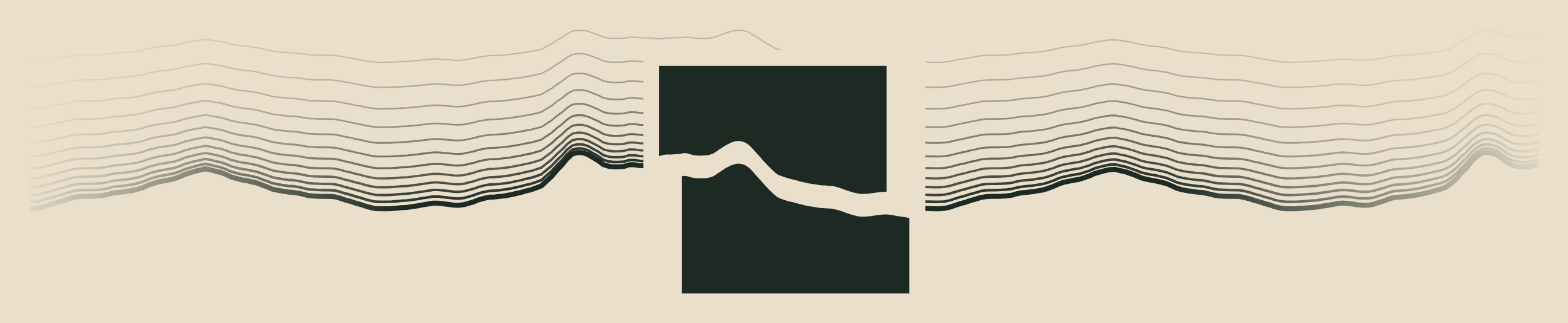
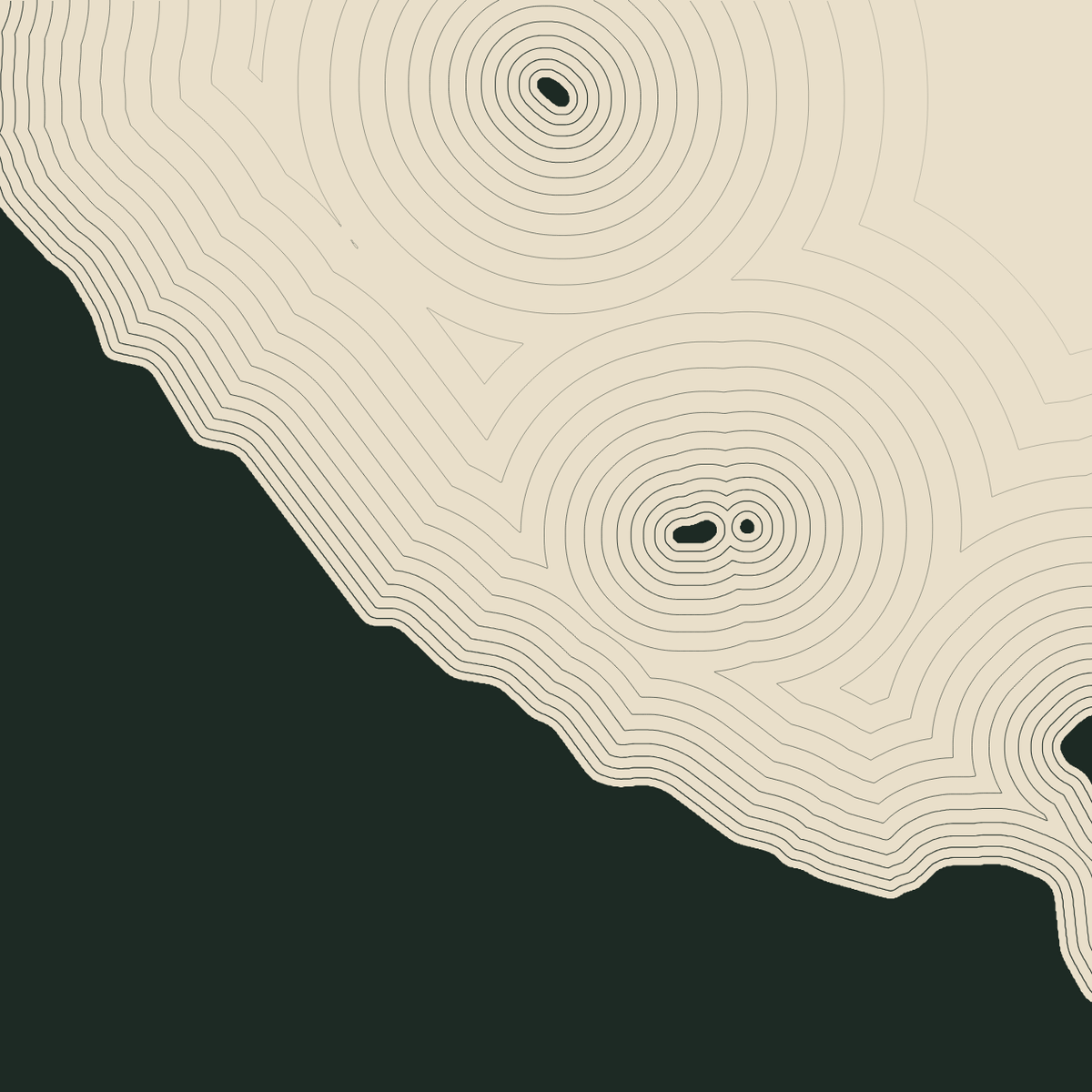
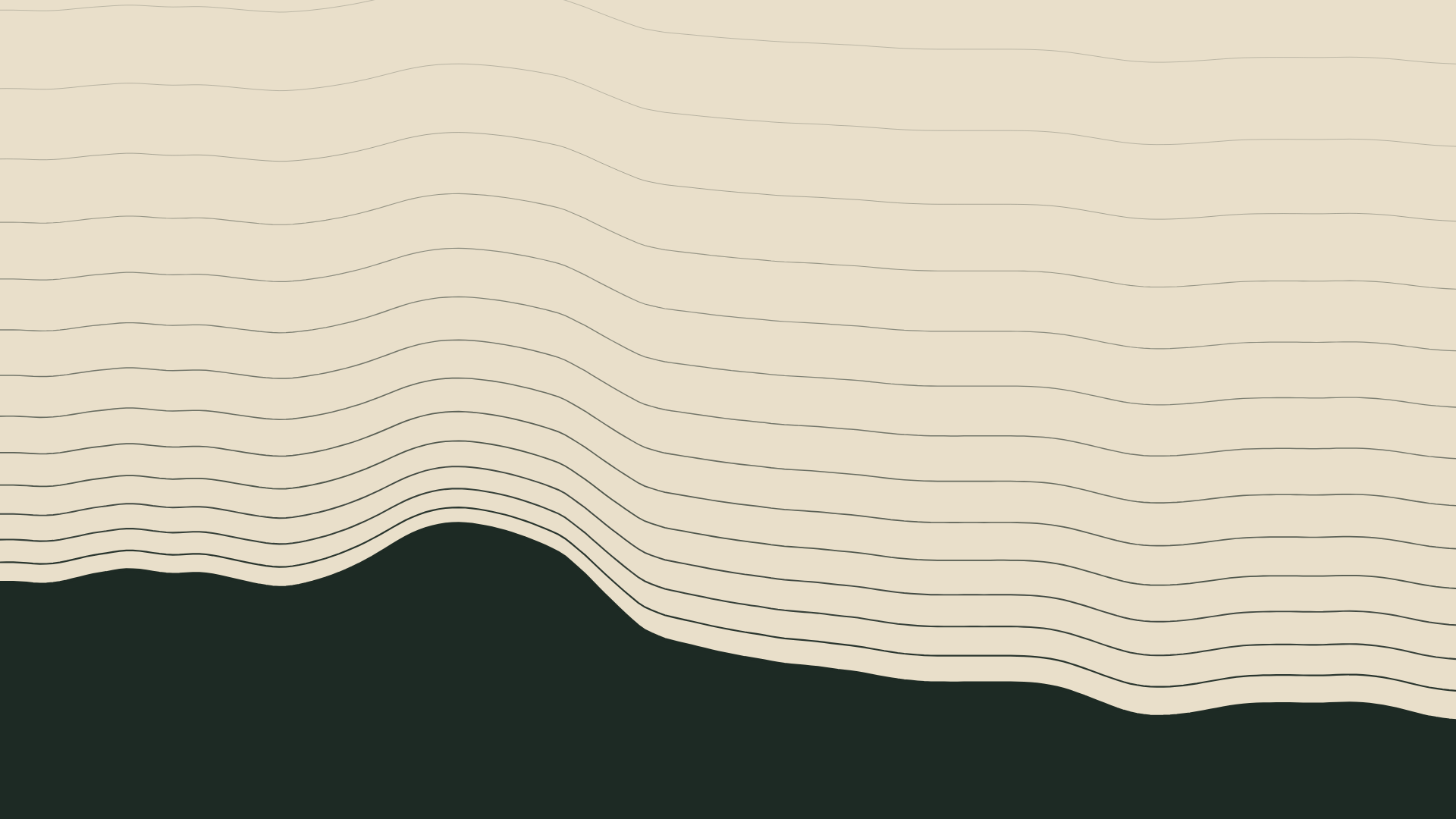
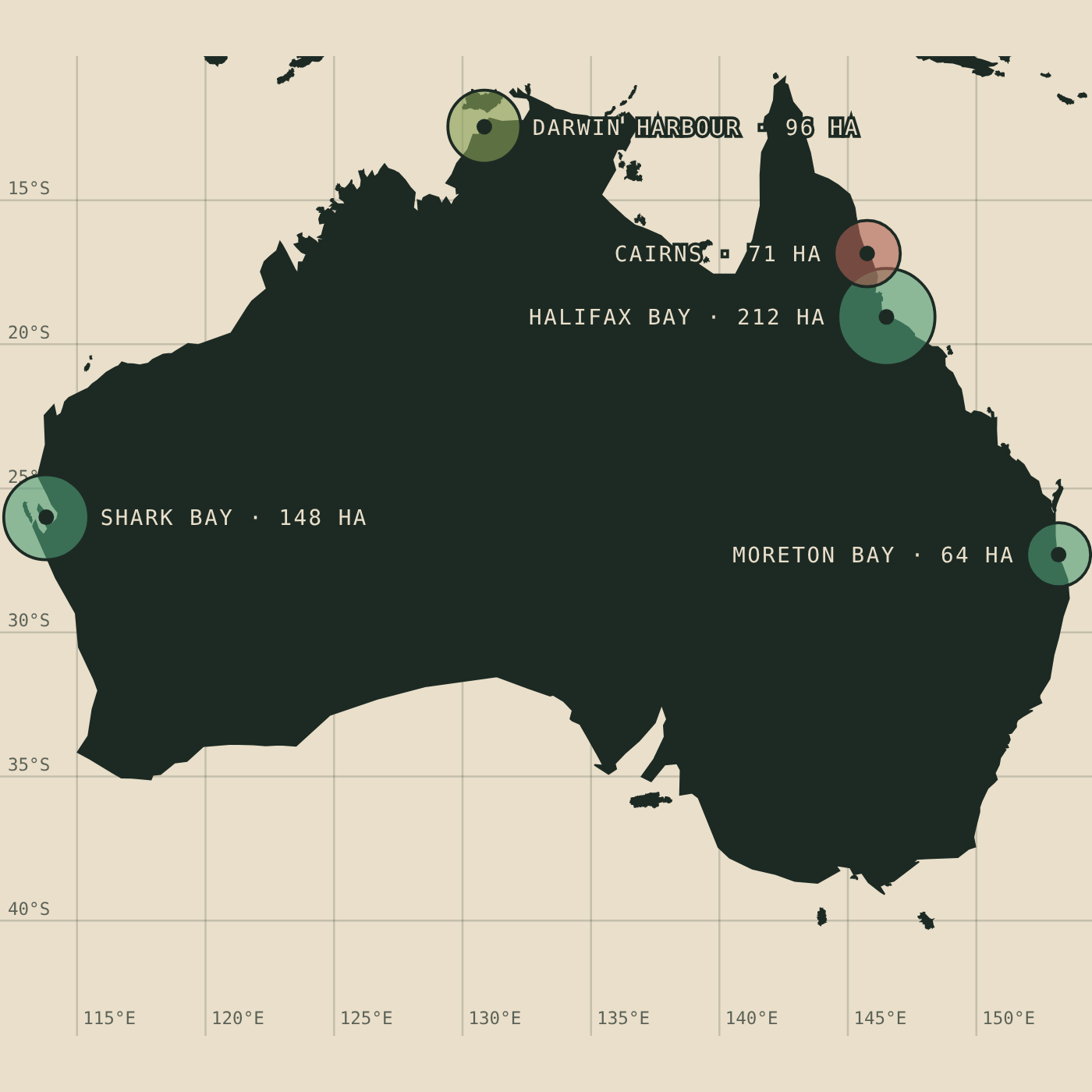
The coastline is never fixed. The same rule that cuts the mark redraws every coast offshore, line after line, and the same lines become the working maps of every project, from the whole country down to the shore where the crews plant.
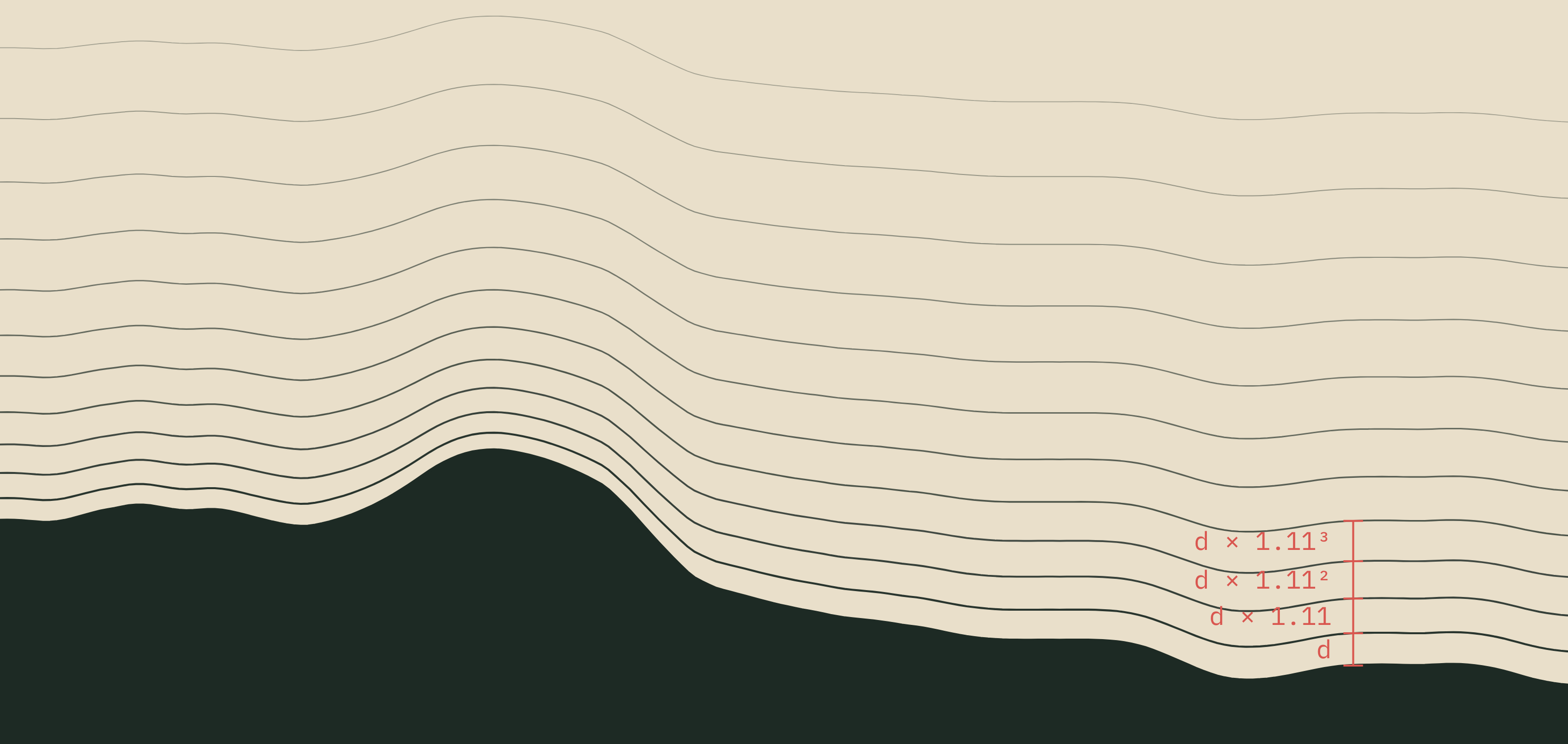
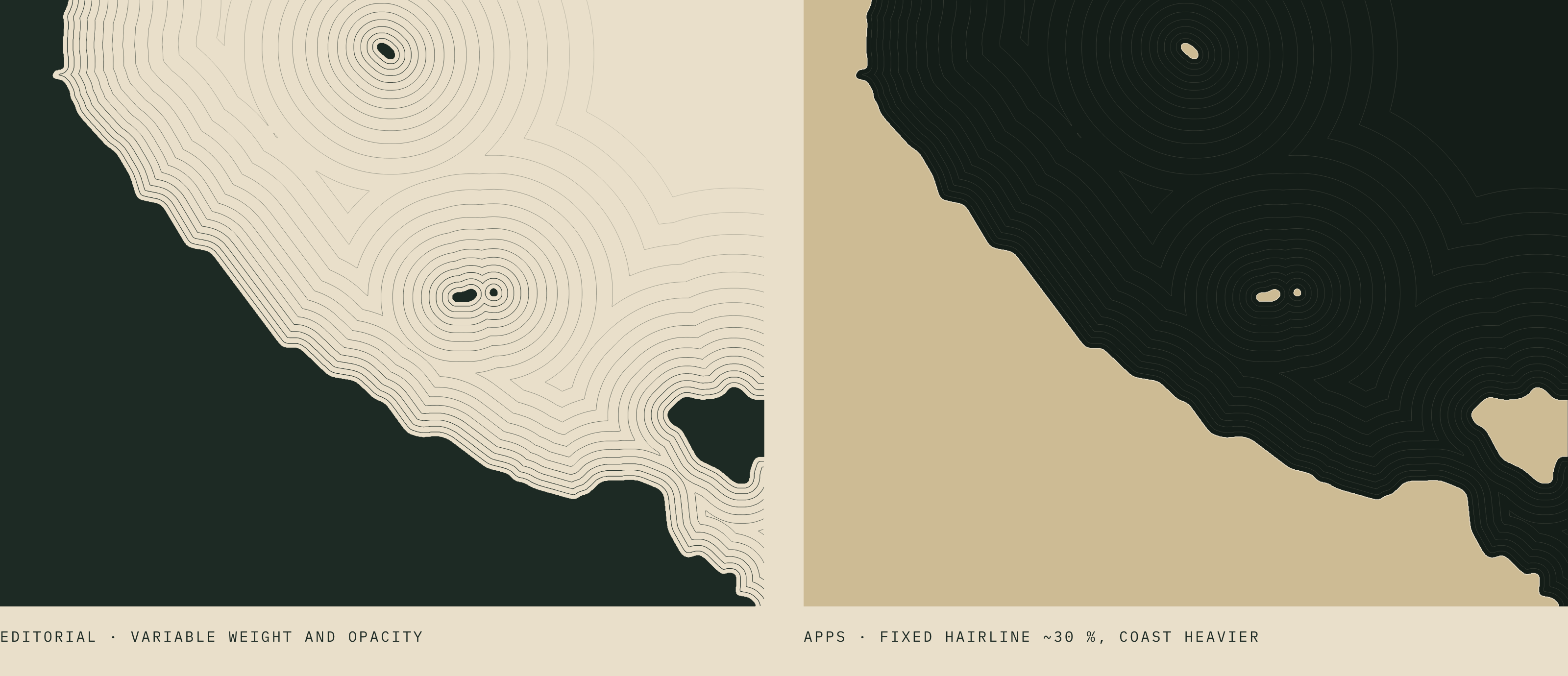
First gap · d · each next gap · d × 1.11
Editorial · 16 lines · weight and opacity fade offshore
Every line comes from a real coast. None is drawn by hand.
19.0°S 146.5°E
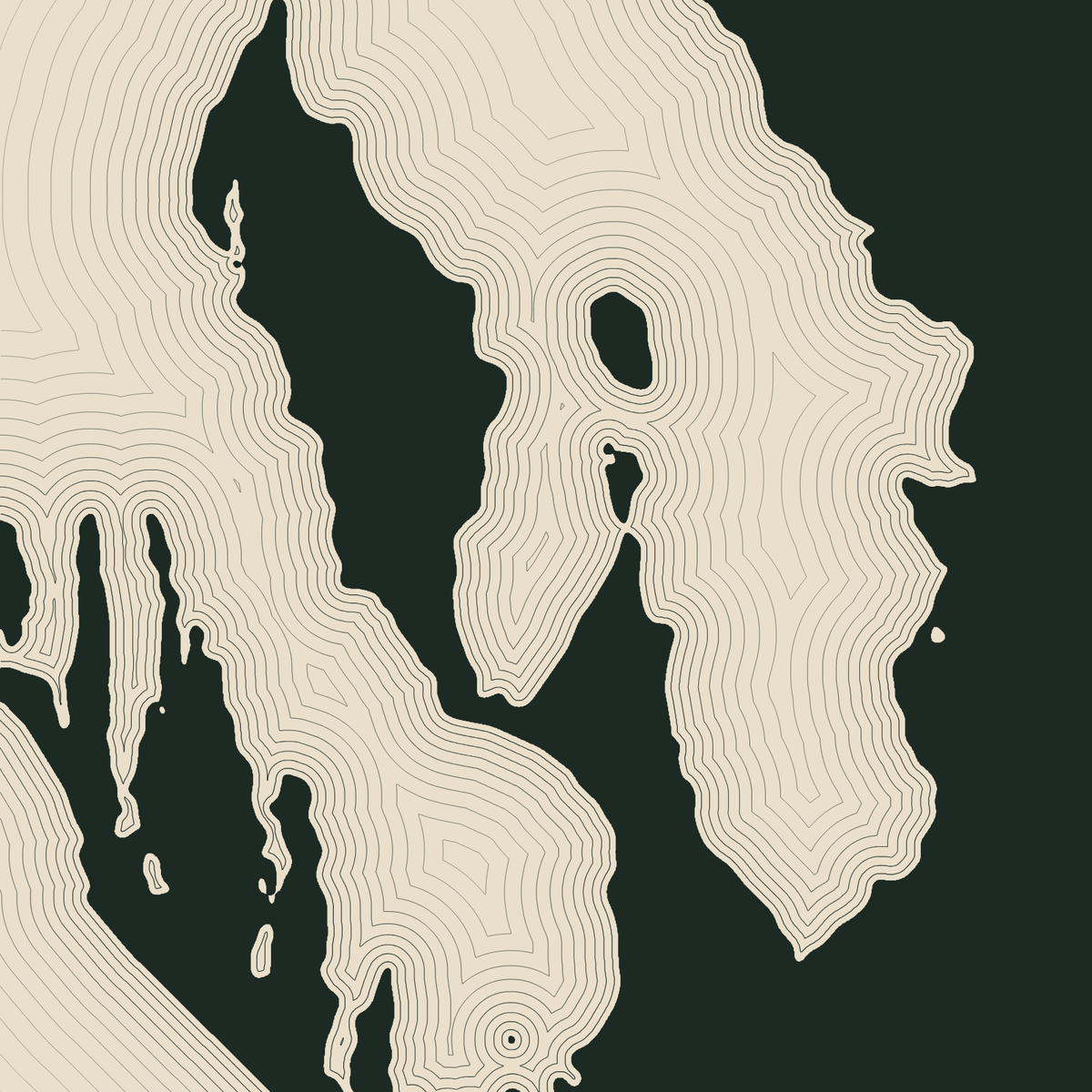
26.1°S 113.8°E
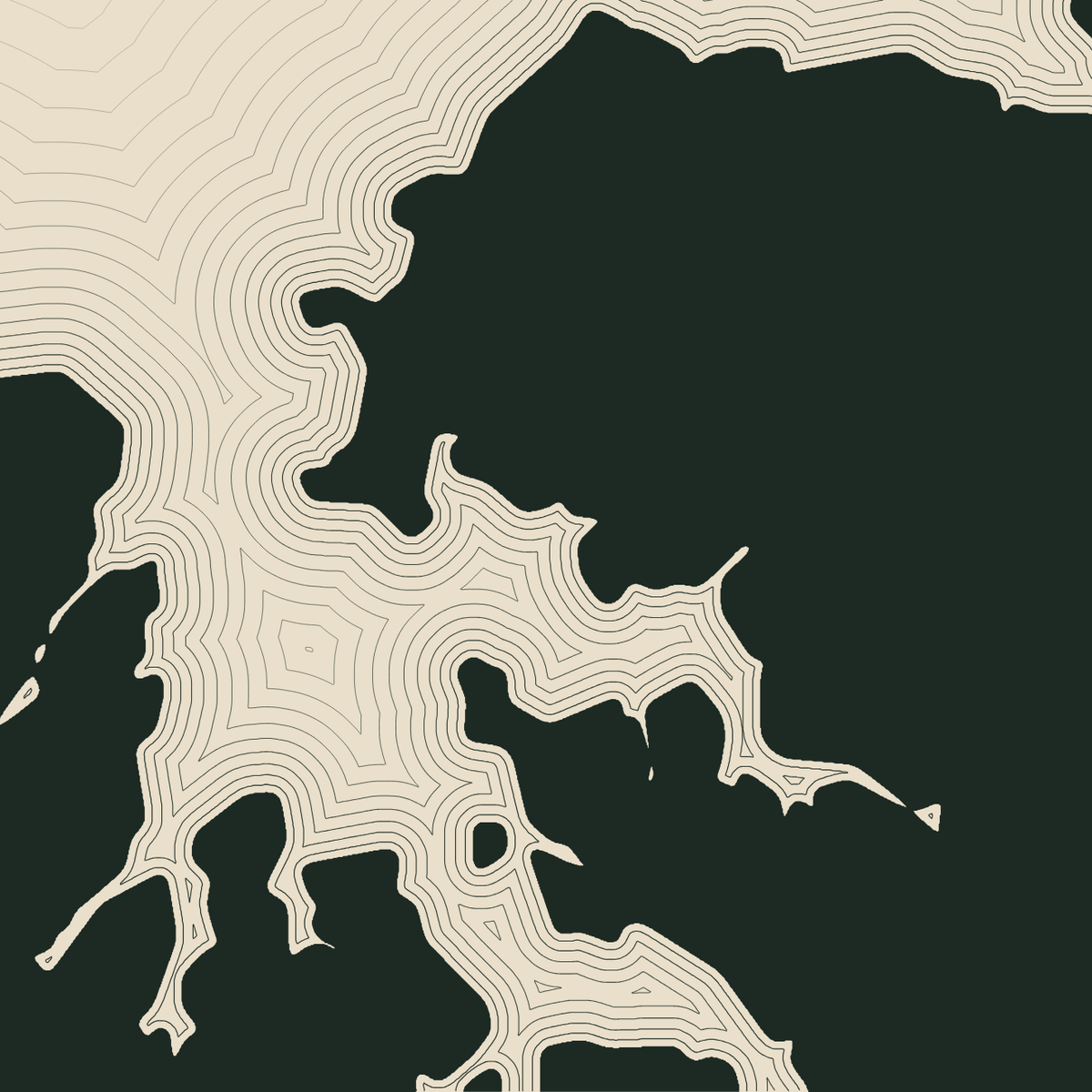
12.5°S 130.9°E
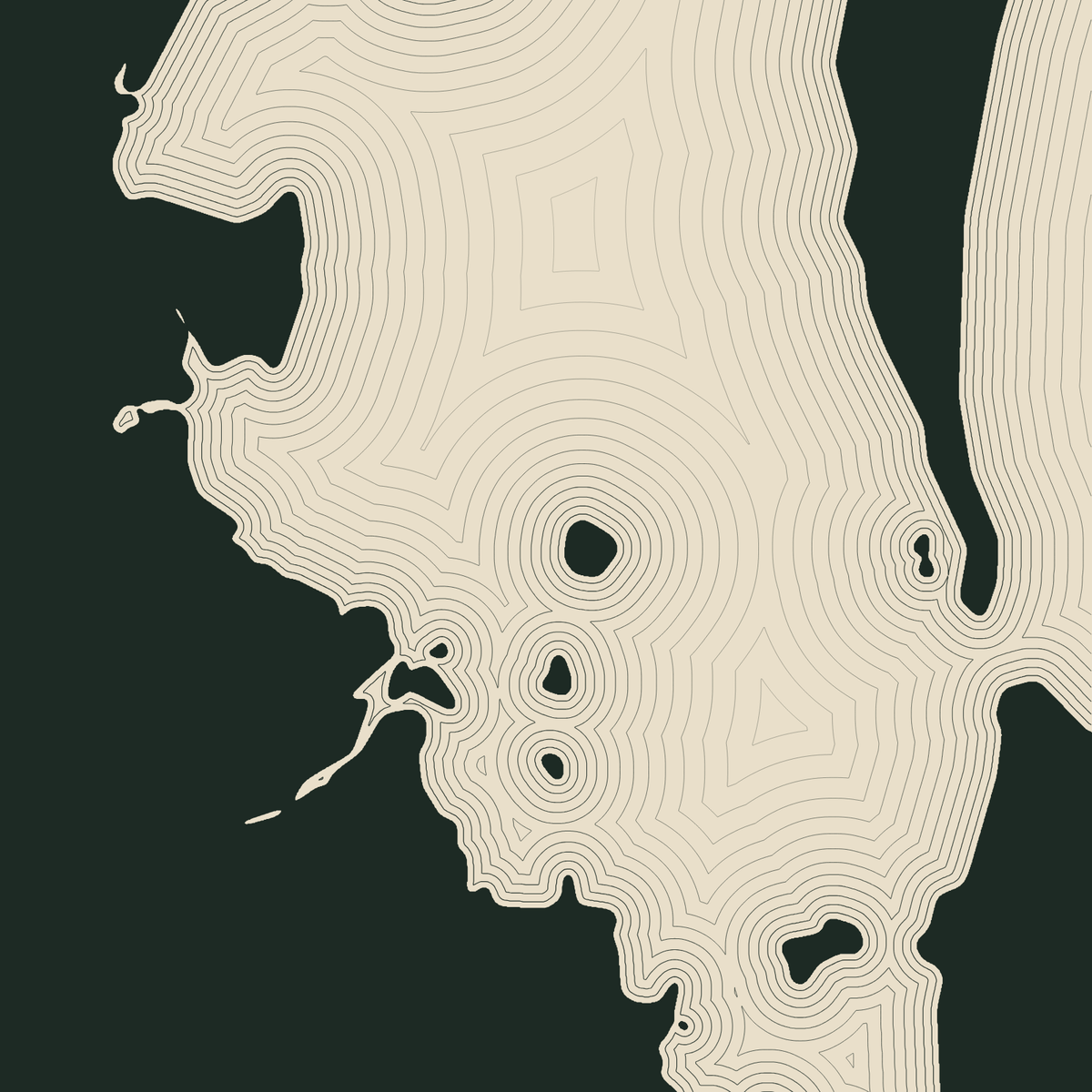
27.3°S 153.2°E
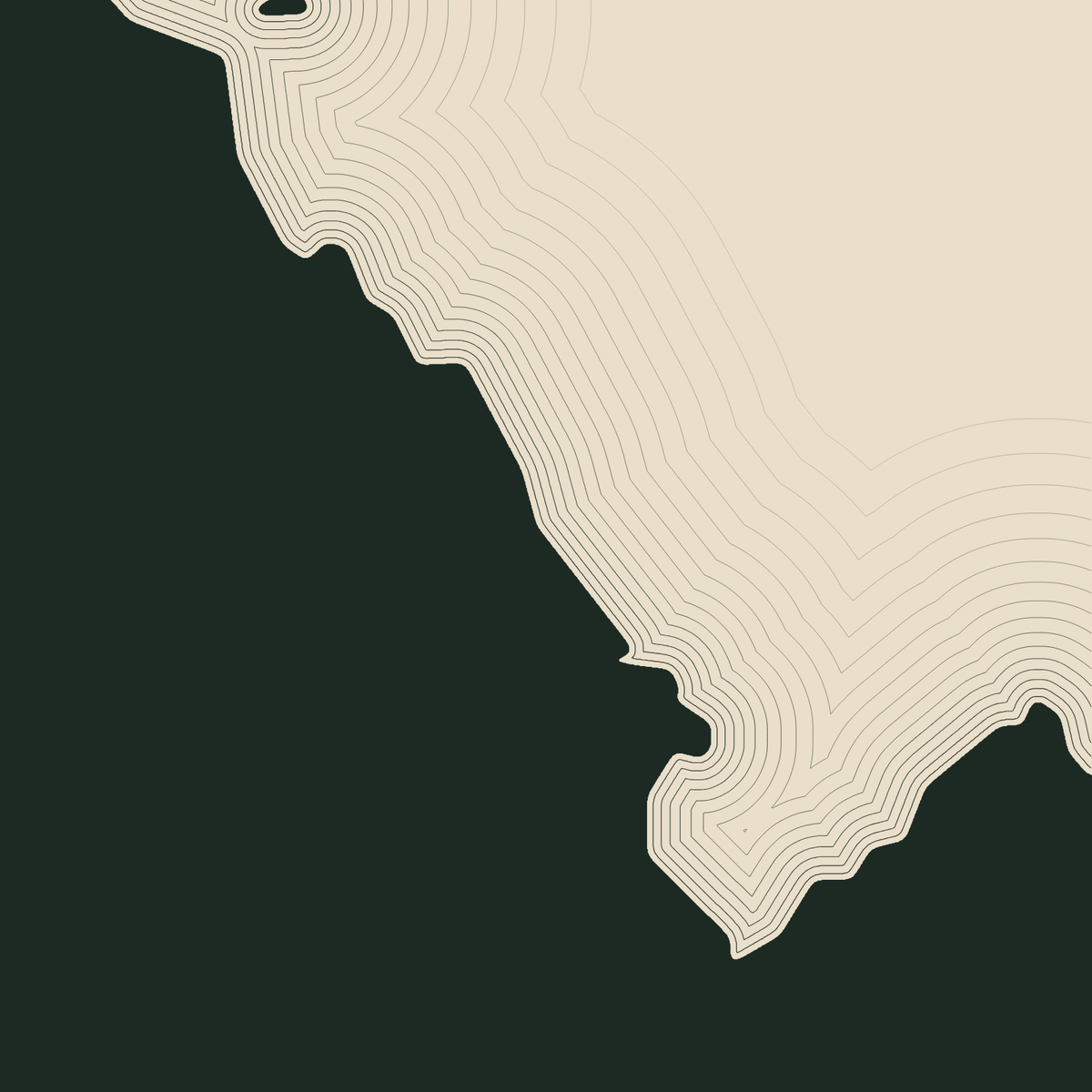
16.8°S 145.7°E
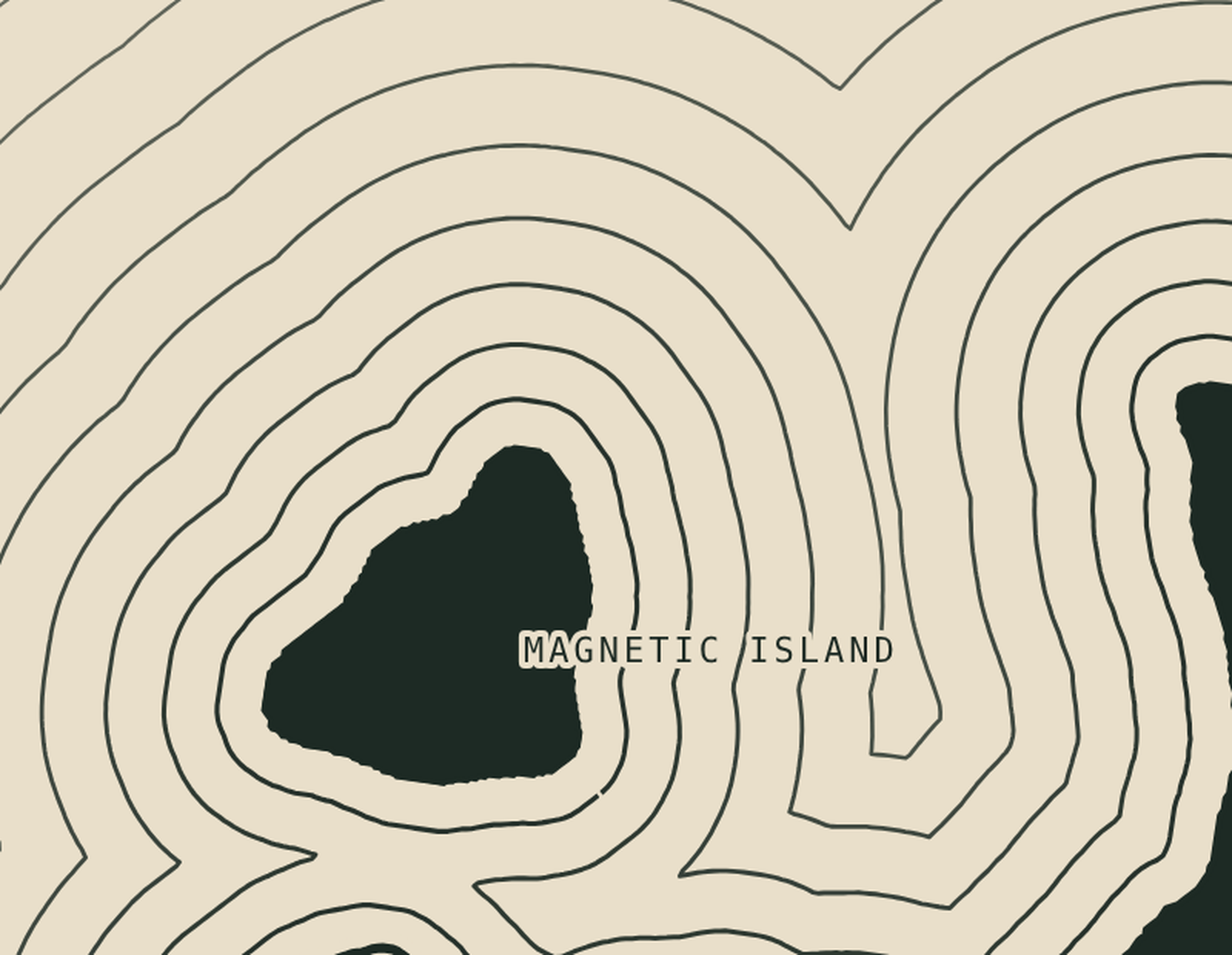
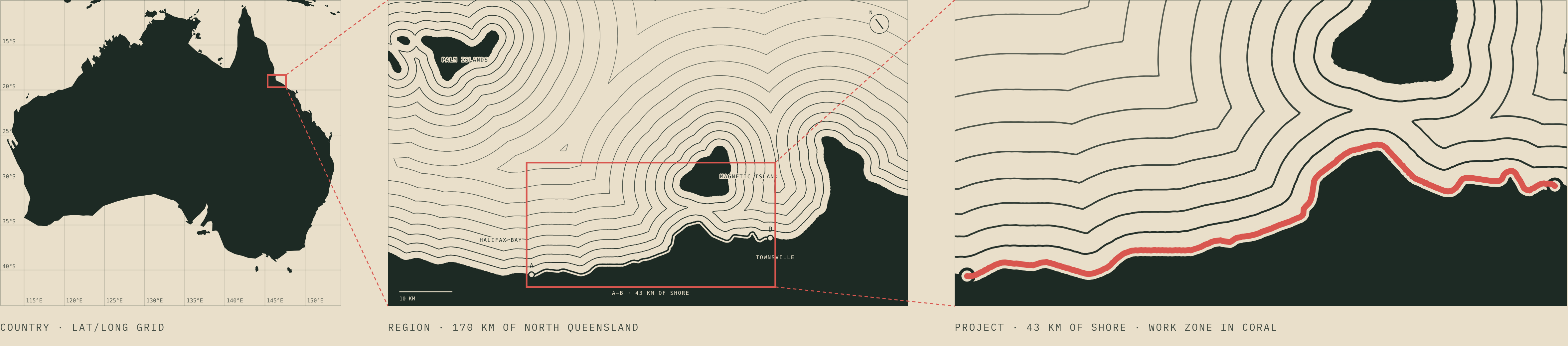
At country scale, a latitude and longitude grid. Closer in, the depth lines take over. Never both on the same map. Coral marks only the work.

The coast leads and coral marks the work. Every map carries a north arrow and a scale, and every label sits on a halo of the background colour.
04 – 08 · The rest of the system, at a glance
Colour, type, icons, layout and data, each in one rule. The full system, with every value, lives in the Figma library below.
04 · Colour
Green and cream do the talking, sand is the land, sea blue is the water and coral is only a spark. Each of the five ecosystems has its own colour, never without its icon or name.
05 · Type
Four voices, one job each. Bitter builds, Newsreader tells the story, Plex Mono proves it and Instrument Sans runs the product. Figures go in Bitter, with the unit in Mono beside them.

06 · Icons
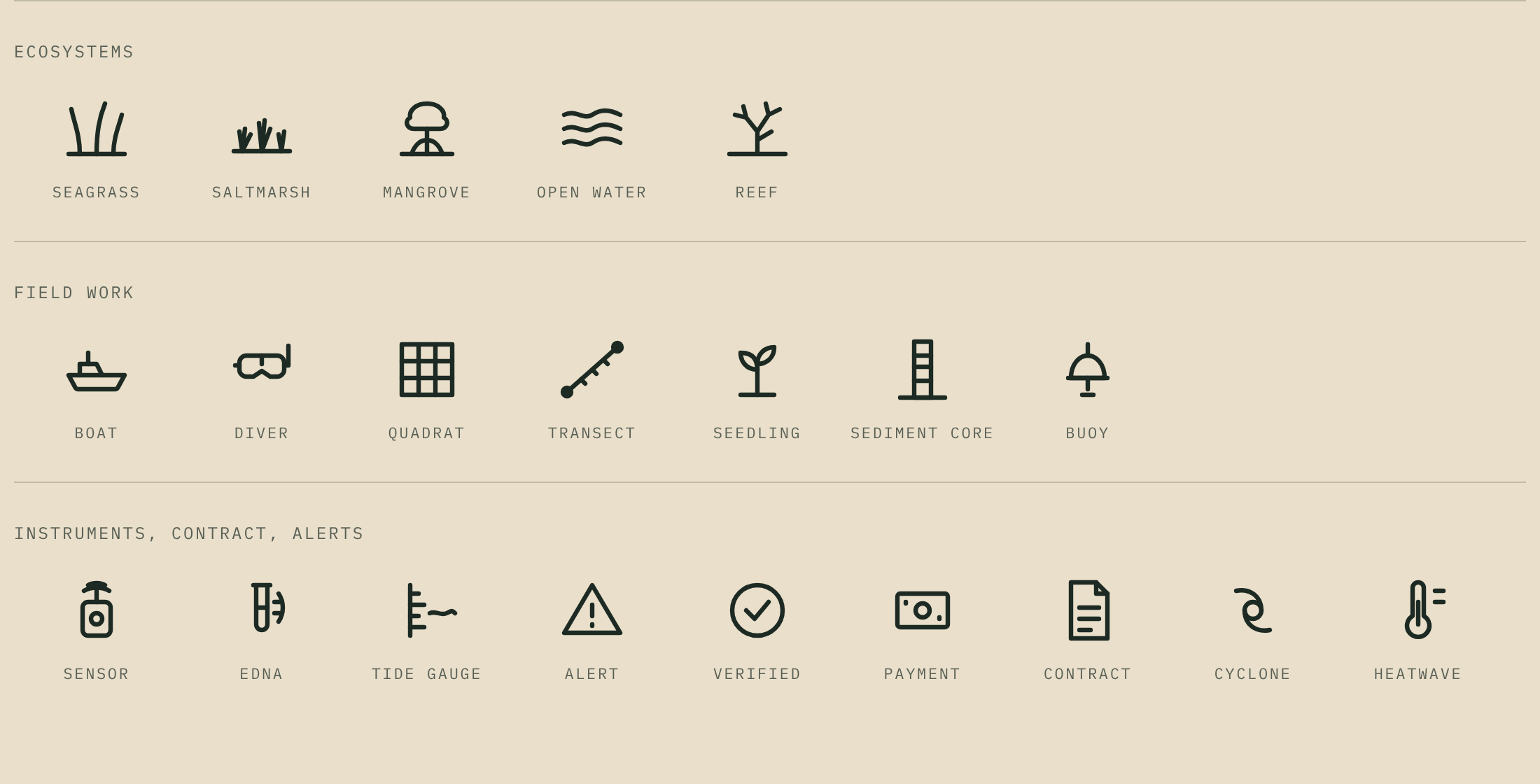
Drawn like a field notebook: one line weight, round ends, no fills. Twenty-one icons in three families, ecosystems, fieldwork and contract, on one 24 px grid for maps, apps and reports.
07 · Layout
Every page has a coastline. Measure the short side, lay twelve columns, then cut the page in two: the place above, the proof below. One rule for reports, slides, signs and app screens.
08 · Data
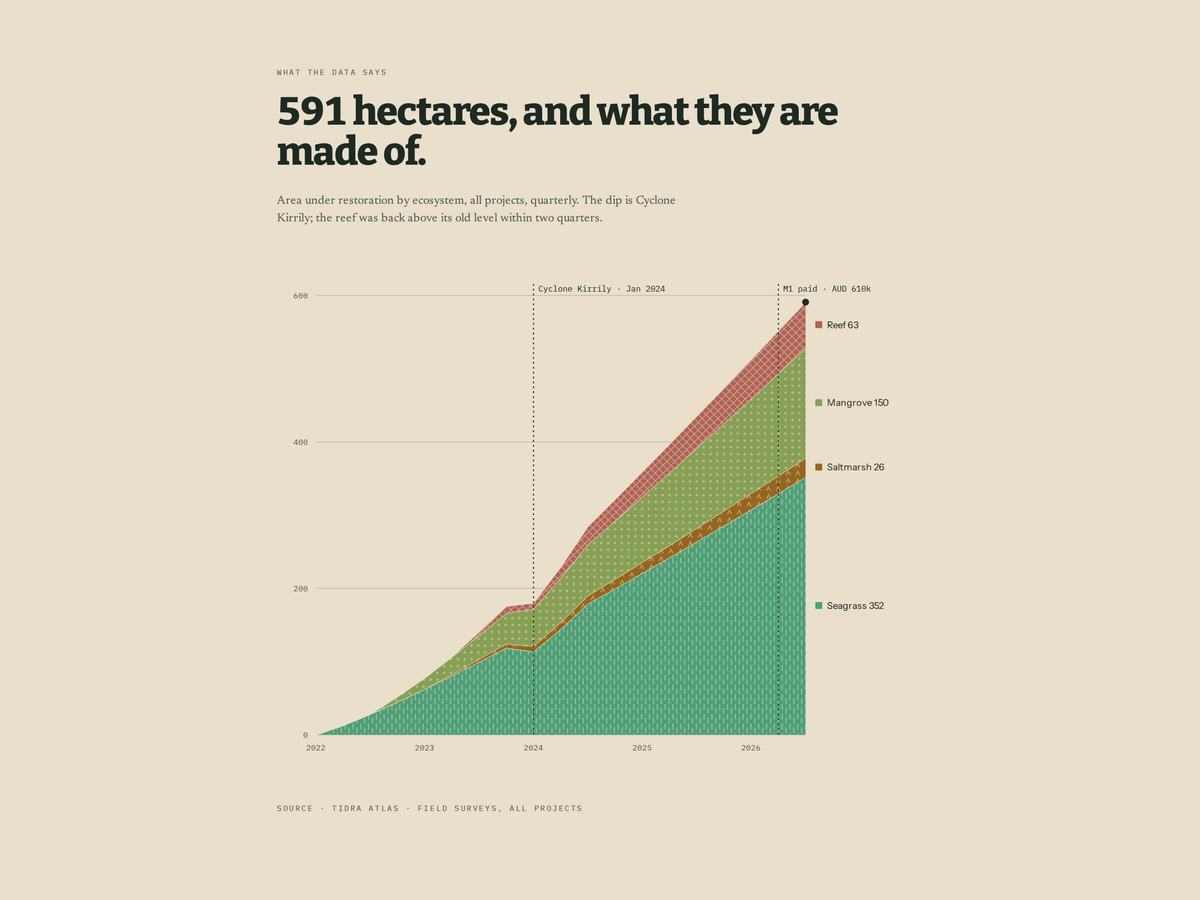
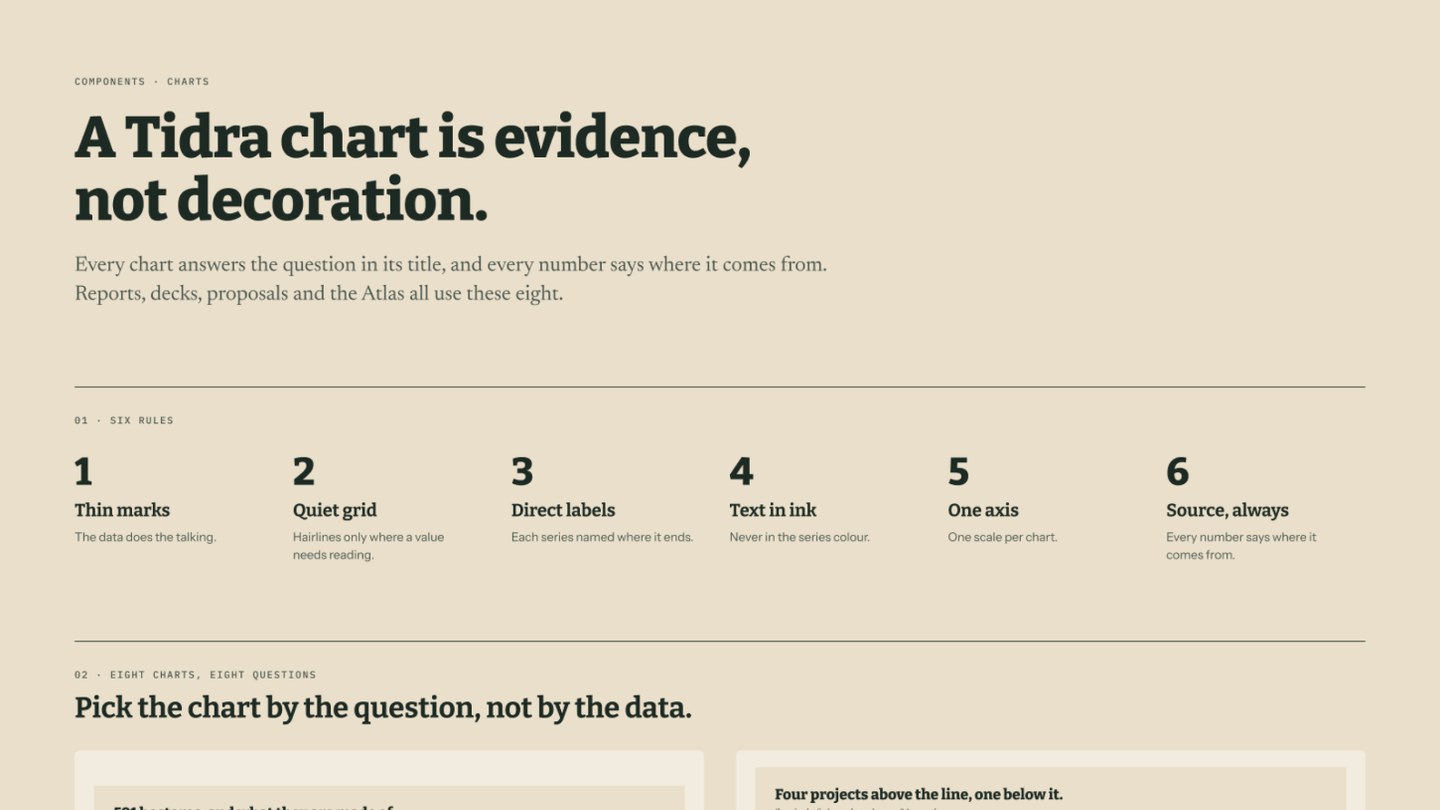
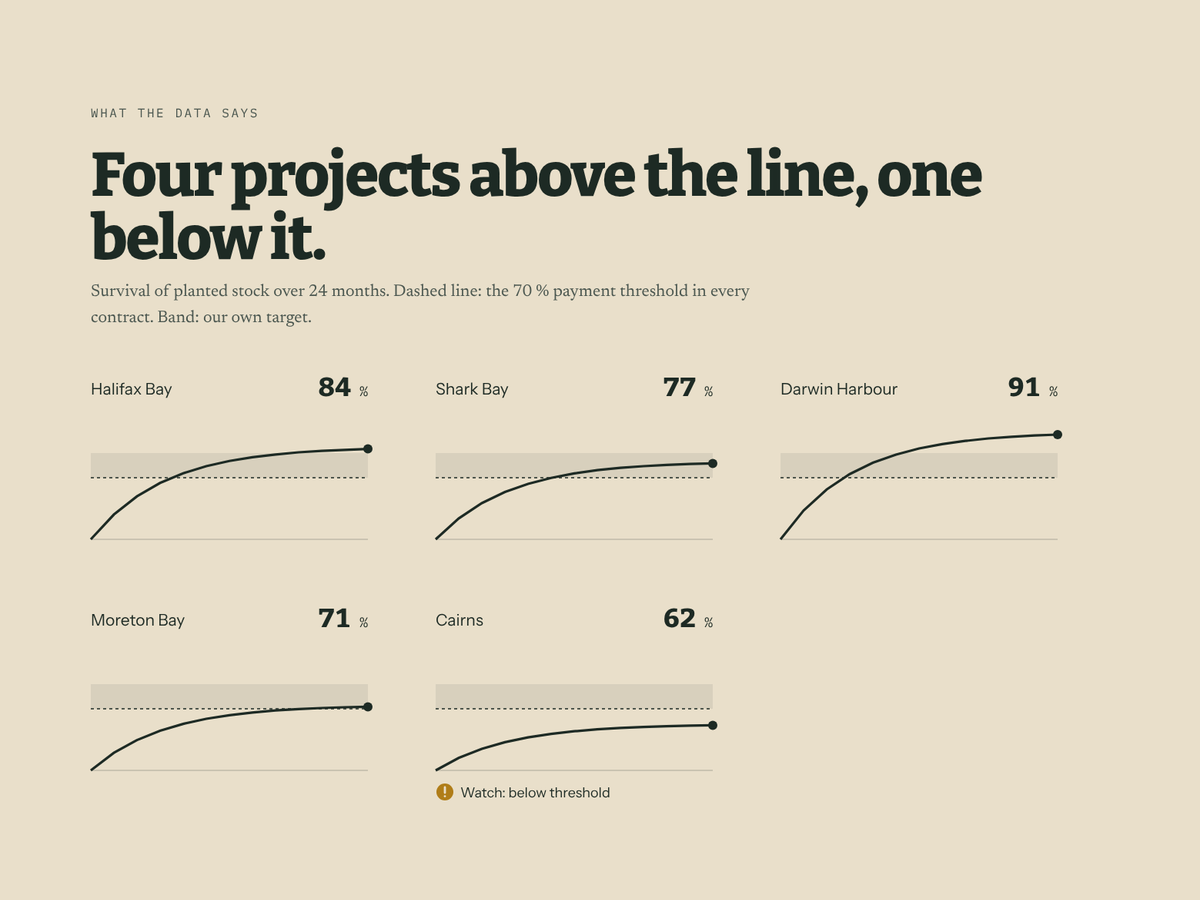
A Tidra chart is evidence, not decoration. Thin marks, a quiet grid, labels where each series ends and a source under every chart. Eight chart types, each chosen by the question it answers.
09 · One source: the design system
Everything above is built as a working Figma library: variables, components, the screens of Atlas and Field, and the templates for email, social, web, decks, documents and print. Teams and AI tools work from it.
10 · Toolkit
Everything a team, an agency or an AI needs to make Tidra without asking: the brand book, the Figma library and a downloadable toolkit, with one naming rule.
tidra_report_HB_A4_v03
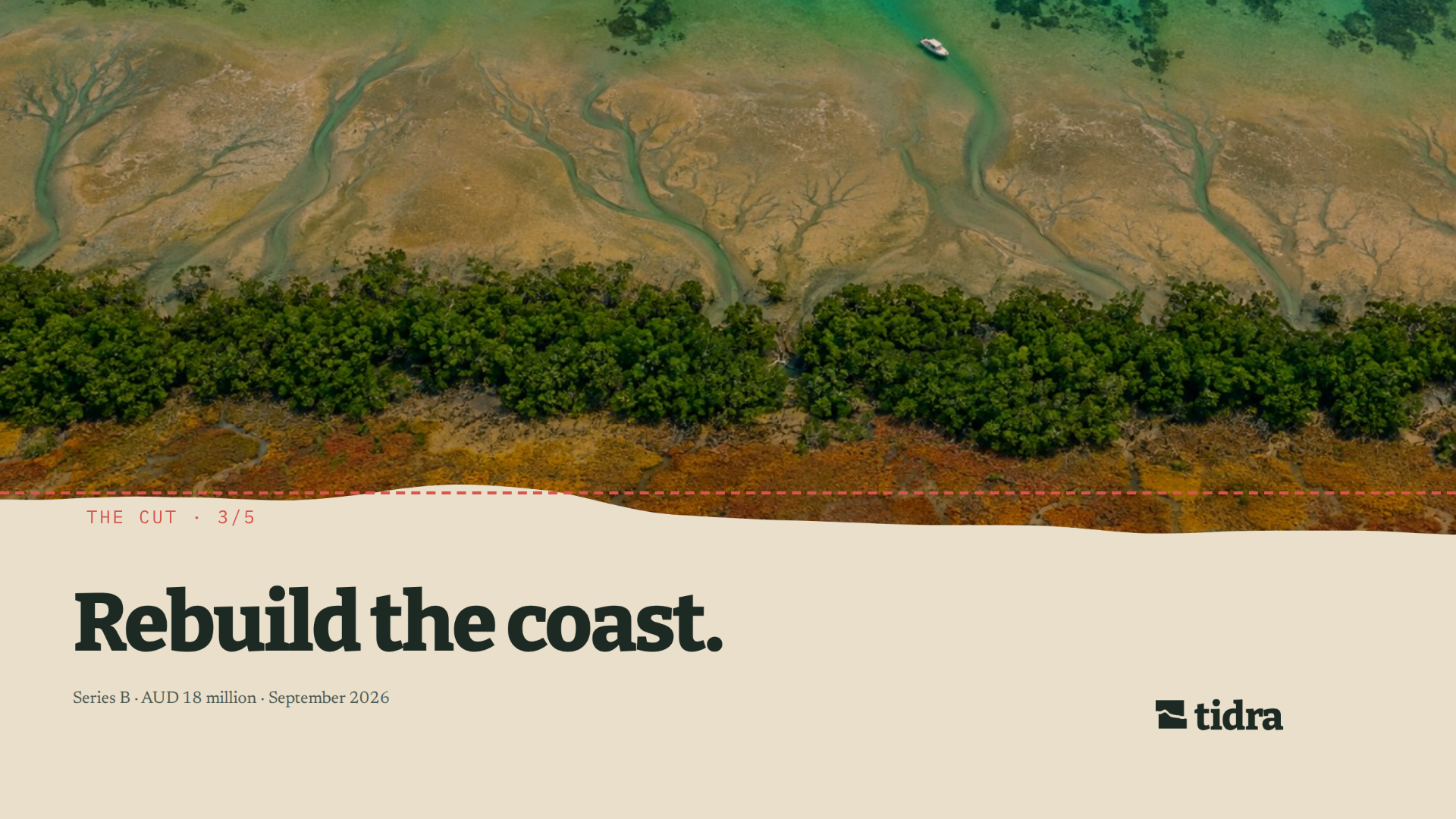
tidra_deck_seriesB_16x9_v07
tidra_hoarding_CN_2400x1200_v02
Version 1.1
Owner · Brand & Communications
If a rule is not in the kit, it is not a rule yet. Ask once, and it gets added for everyone.
Four tools, one dataset.
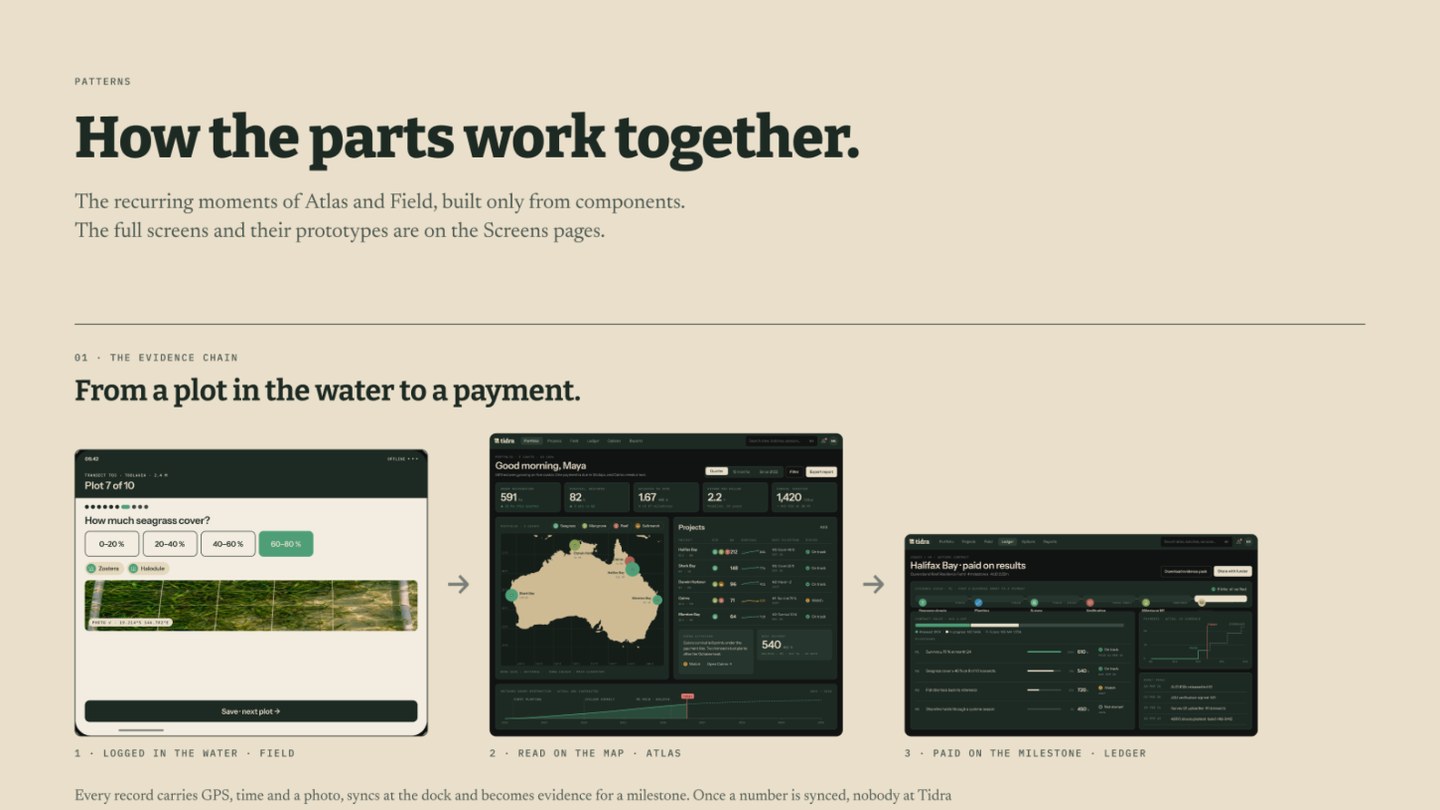
What a diver logs in the water is what a council reads on screen and what an investor gets paid on. Tidra's products share one dataset, one design system and one rule: every number can be traced back to the coast it came from.
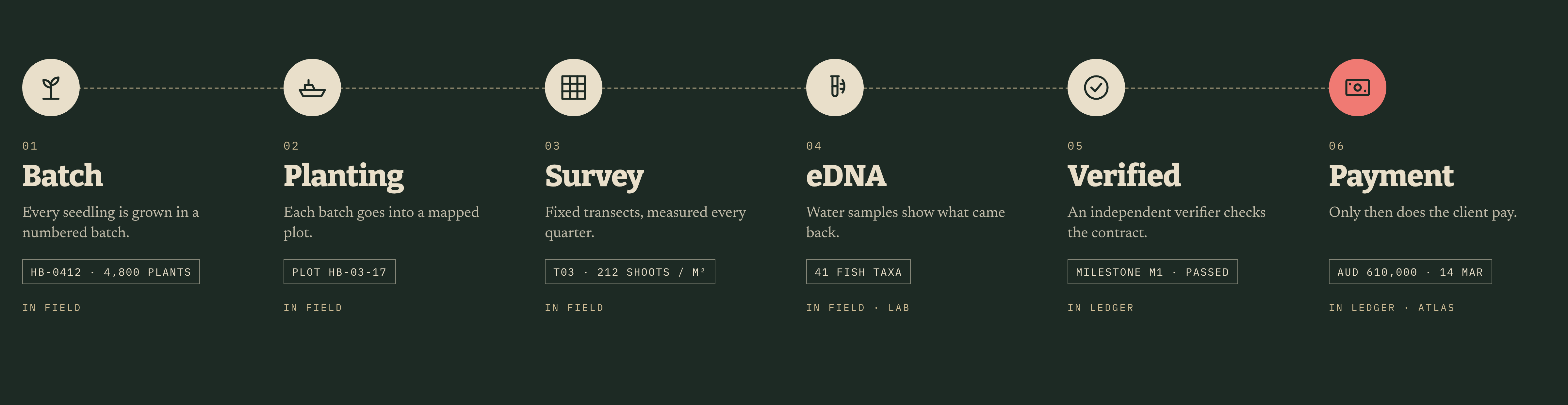
From a seedling to a payment.
Measure what comes back.
The Atlas is Tidra's web platform, and the place where every project lives. It opens on a map of the country with every coast Tidra works on, and from there you can zoom into a single project: its depth lines and planted plots, the hectares growing back season by season, the sensors in the water, the species found in each water sample, and every storm or heatwave that has hit it along the way. The Ledger sits inside the Atlas and holds the contract. Each milestone shows what has to be proved, who proves it and what it pays, and each payment links back, step by step, to the batch of plants, the survey and the verifier's sign-off behind it. Clients, investors and the independent verifier all read the same screen.
Directors, clients and investors on the Atlas. Clients and the independent verifier on the Ledger.
See every coast in one place, follow each project through time, and link every payment to the evidence behind it.
The map is the home screen, not a dashboard of cards. And once a number is synced, nobody at Tidra can change it.
A brand that gets wet.
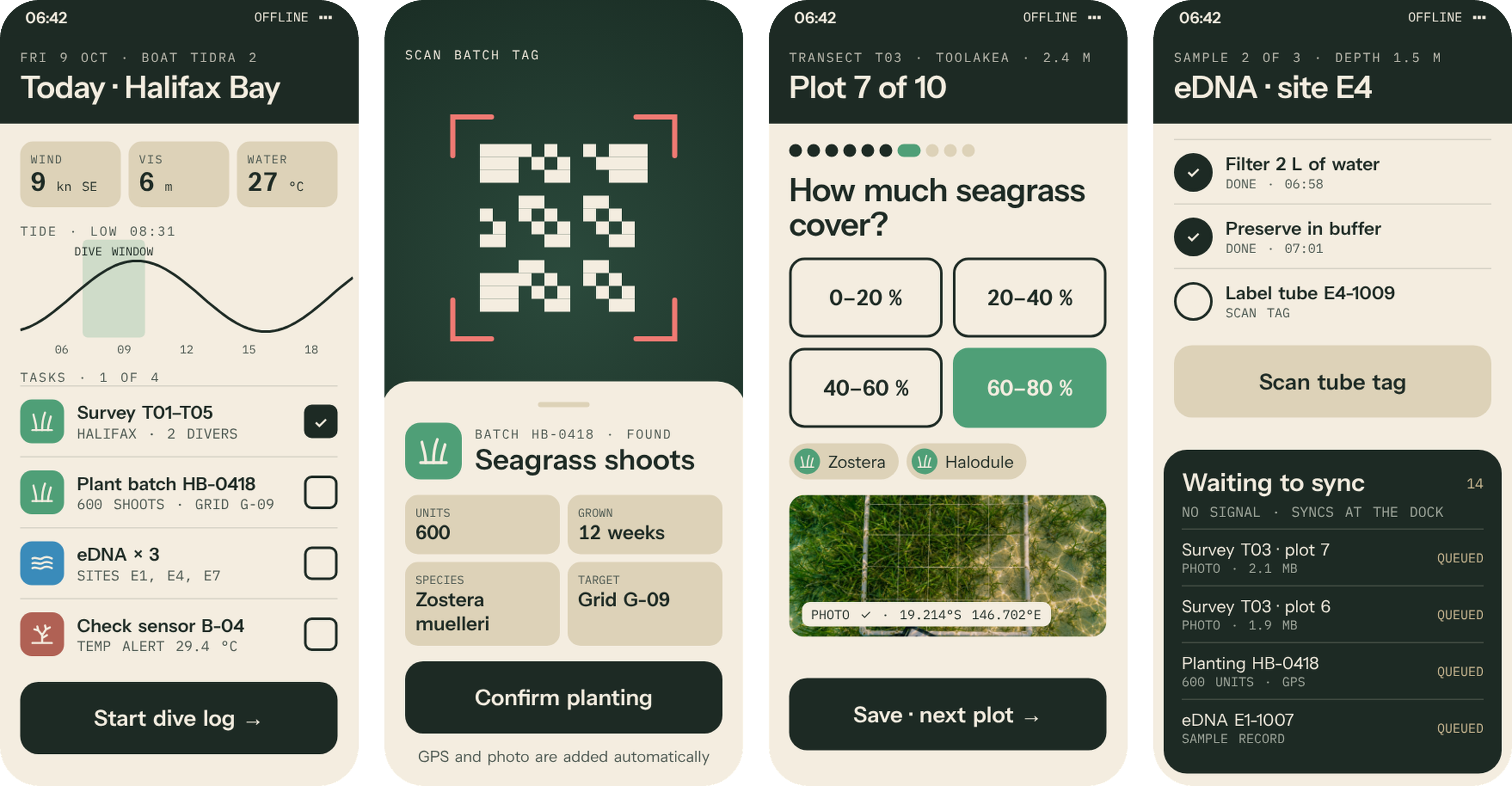
Field is the app the crews carry on the boat, on the reef and on the mudflat. It turns a working day into a short list of tasks: the tide window, the batches to plant, the transects to survey, the water samples to take and the sensors to check. Every batch tag is scanned, every plot is photographed and placed by GPS, and every answer is a single tap, so a diver in gloves can log a survey in seconds. There is rarely signal at sea, so Field works offline and keeps everything in a queue that syncs when the boat is back at the dock. That data is what the Atlas, the Ledger and the reports are made of.
Field crews on boats, mudflats and reefs.
Log batches, plots, surveys and water samples with no signal, and sync at the dock.
Cream screens, big targets and high contrast, built for salt, glare and gloves. The only Tidra app that runs light.
Concrete or coast?
Options is the web tool Tidra opens to a council before there is any contract. It models two ways of holding the same stretch of coast: a seawall, and a living shoreline of reef, seagrass, mangrove and beach. Both run through the same storms, the same sea-level curve and thousands of simulations, and Options shows what each would cost over thirty years, what the living shoreline gives back in avoided damage, fisheries and carbon, and how the answer changes if the assumptions change. The council's engineers get their own access, so they can test every assumption themselves instead of taking Tidra's word for it.
Council engineers and elected members, before a decision.
Compare a seawall with a living shoreline on the council's own coast, under its own assumptions.
The council keeps the model. Its engineers can change every assumption, and the answer updates in front of them.
In the worst case the coast still costs less. That is the line councillors remember.
The public face.
The public website is for the people who live by the coast, not for investors. It explains in plain words what Tidra does and how it only gets paid when the coast comes back, shows every project on a map with what is happening there now, and publishes each year's impact report in full. It is also where the codes on beach signs, site hoardings and campaign posters lead, so a neighbour standing on the sand can see what is being planted in front of them, who is paying for it and what the town is being asked to decide.
Residents, councils and anyone who scans a code on a beach sign.
Explain in plain words how Tidra works, where it works and how it gets paid.
The same living lines and figures as the reports, written for a neighbour, not an investor.
Written for everyone who has to say yes.
A restoration company has many readers: a council deciding on a seawall, an investor, a regulator, a neighbour on the beach. Every piece in this chapter is built from the same system, and every number in it traces back to the Atlas.
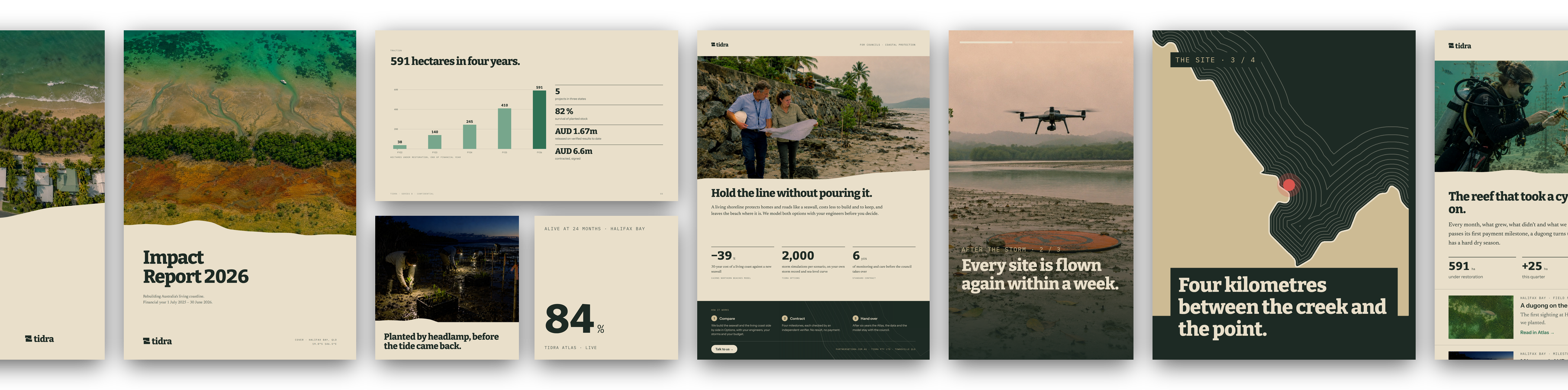
The annual report reads like a field journal with a ledger attached: one page per coast, a chronicle from the mudflat, and every chart with its source line.
Funders, councils and the people who live on these coasts.
Show a year of work as proof, coast by coast.
Every chart names its source, and the one missed milestone is printed, not hidden.
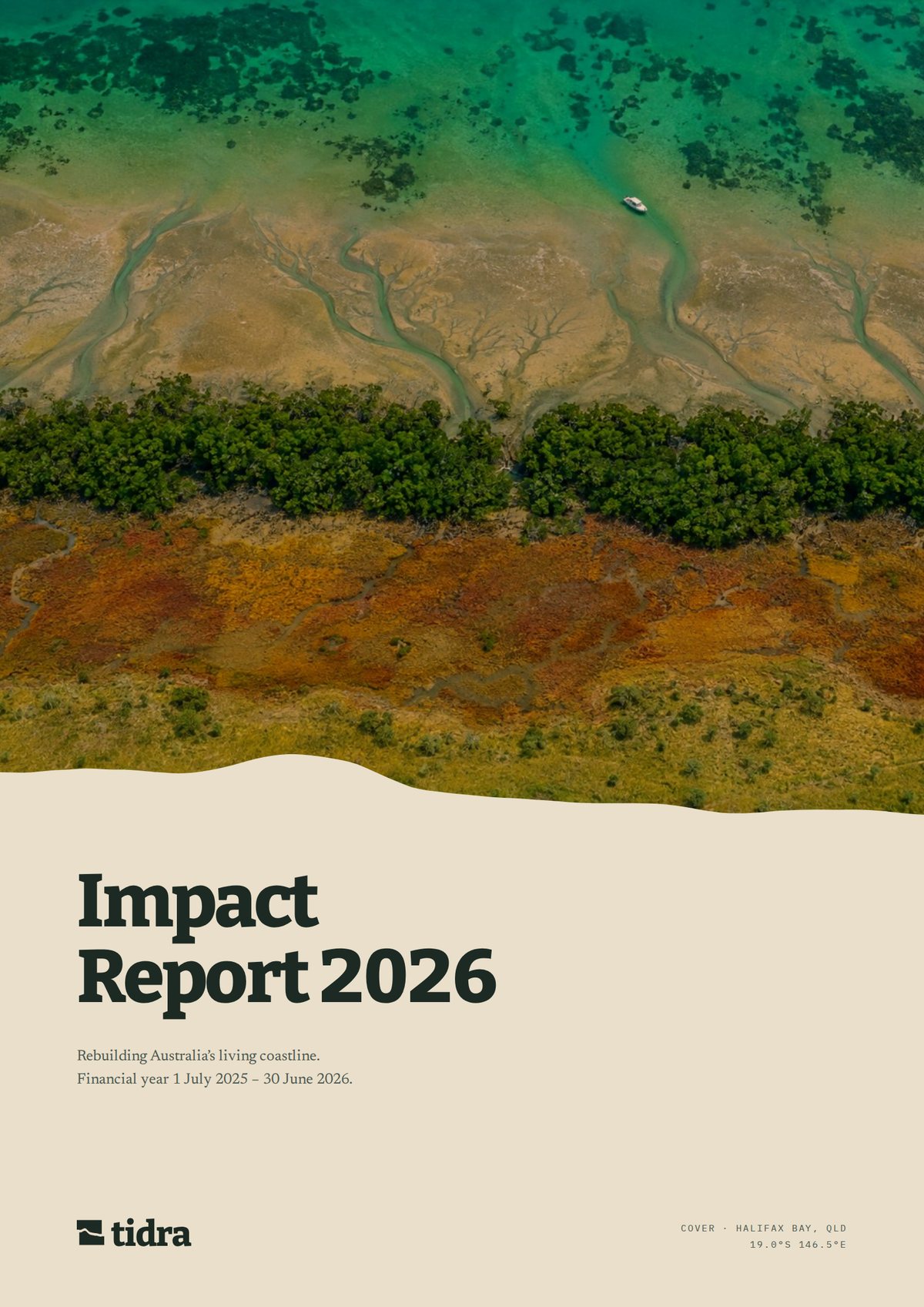
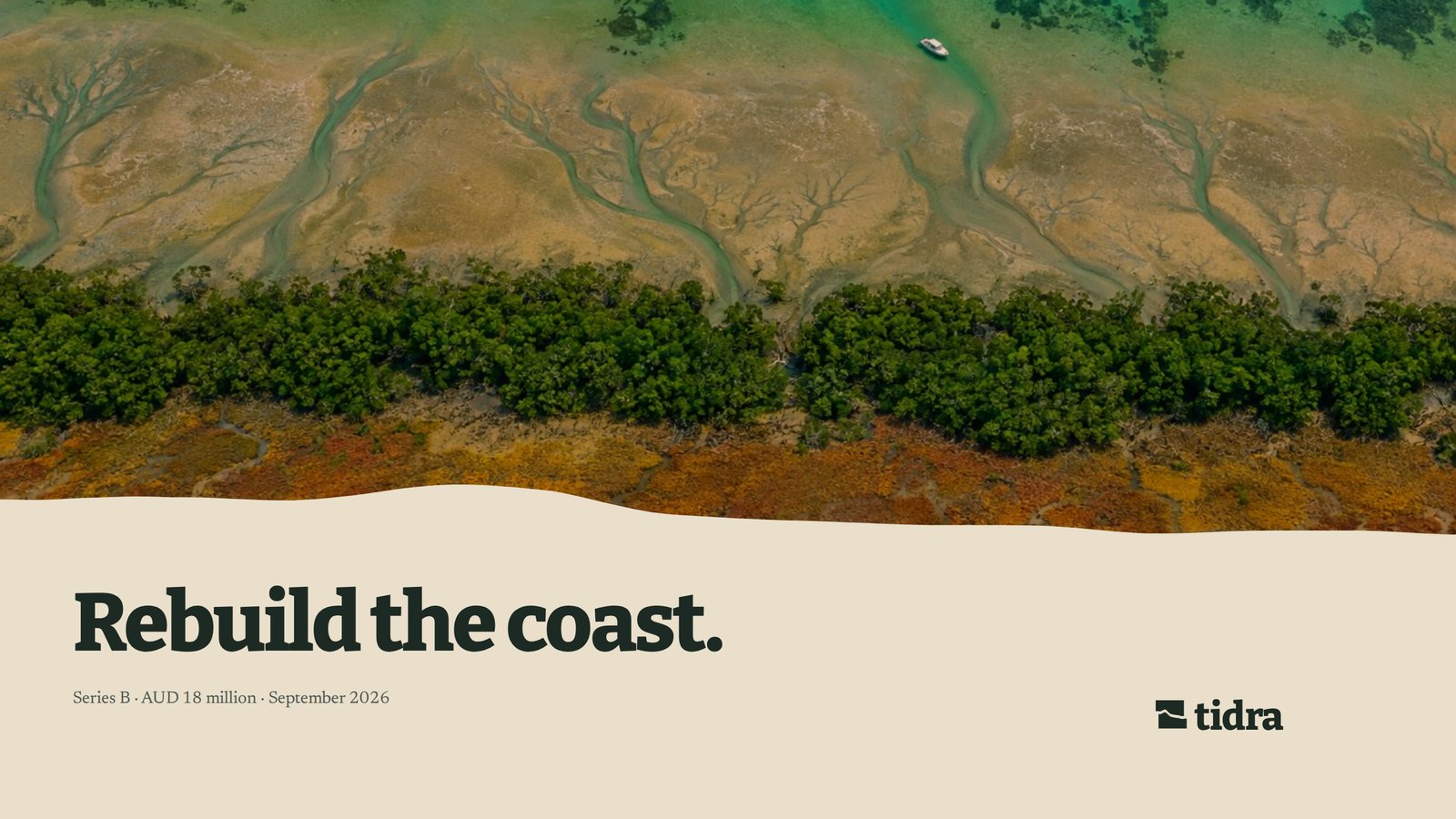
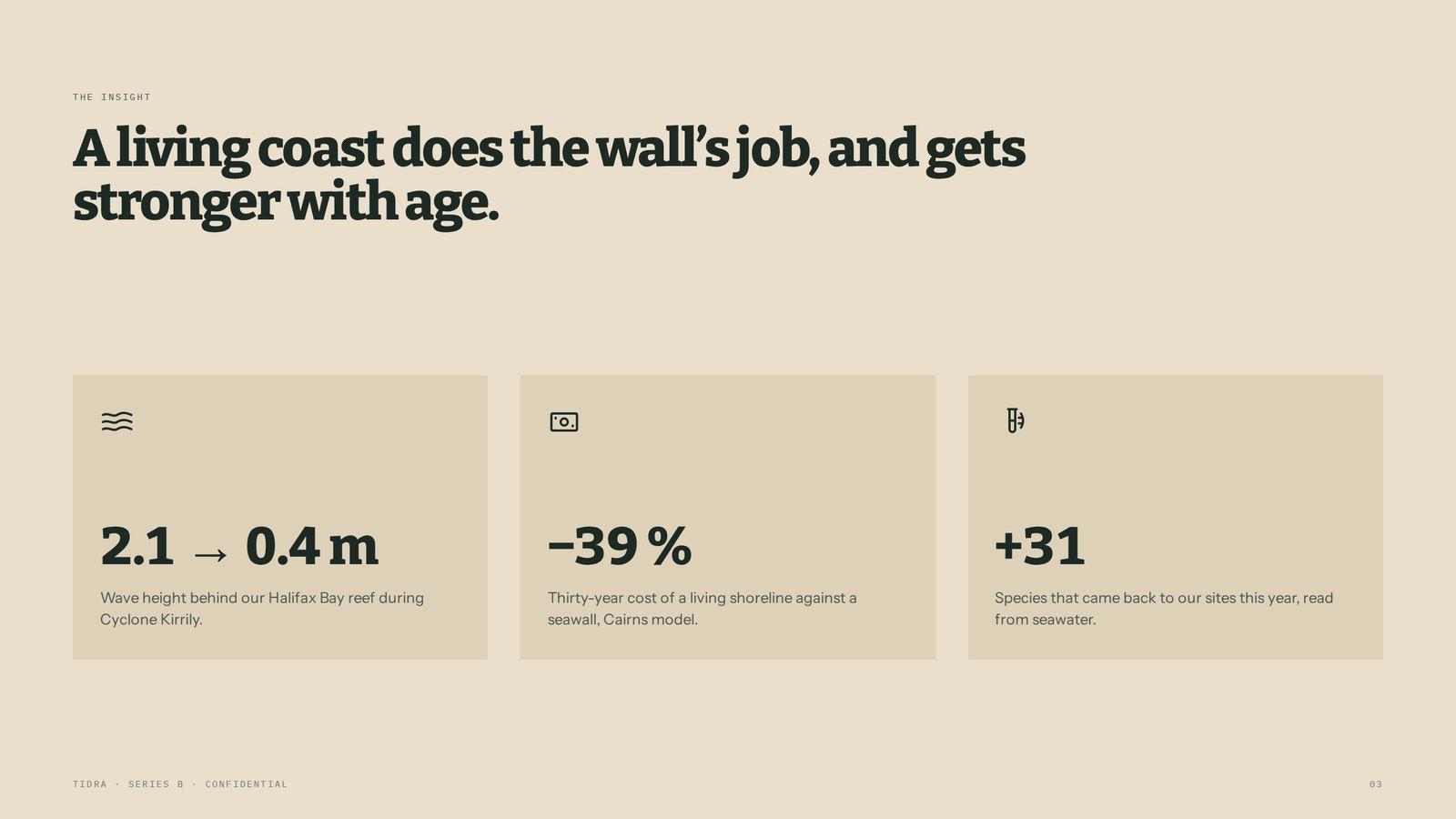
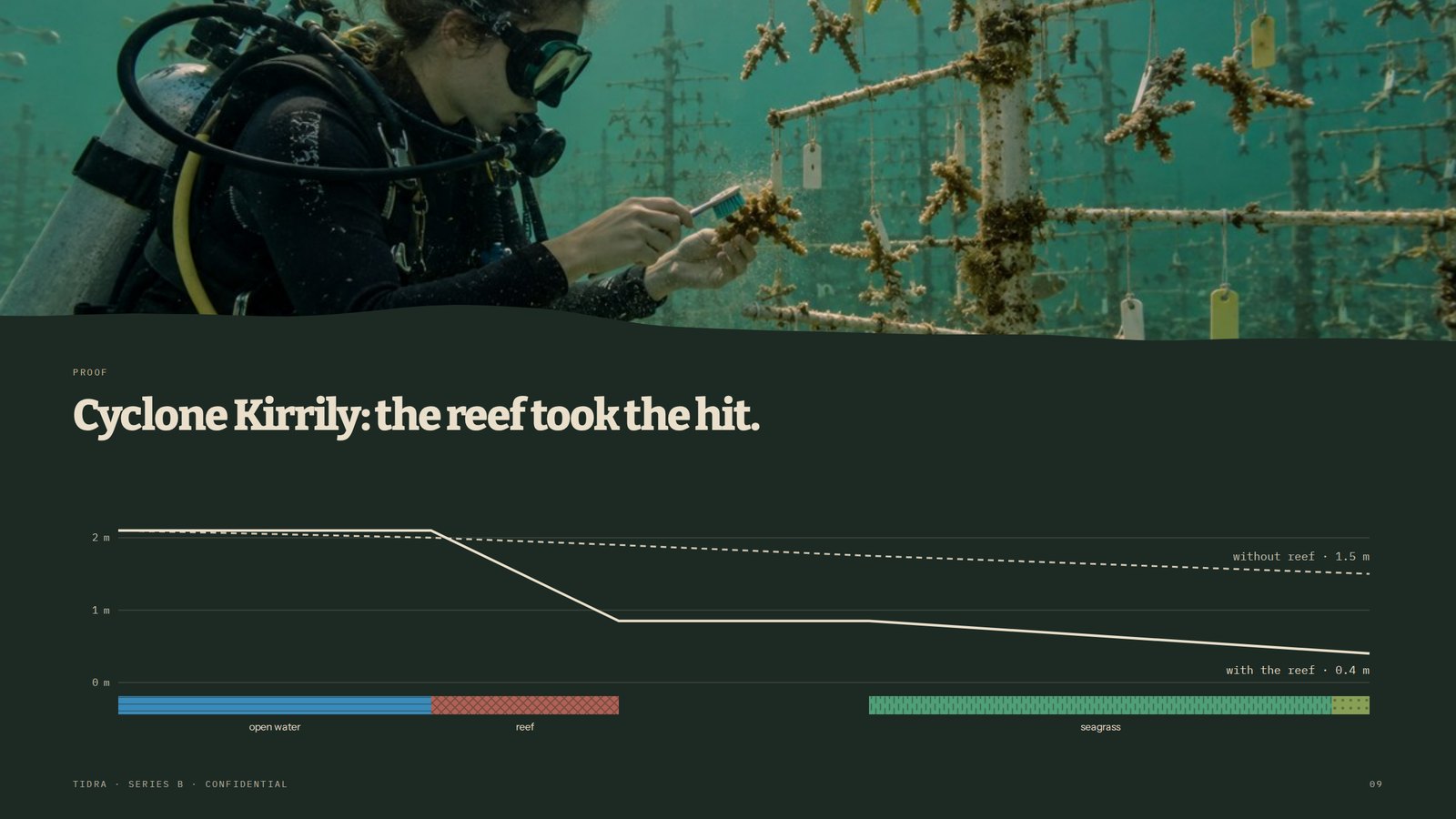
The investor deck tells one story in sixteen slides: Australia pours concrete, a living coast does the job better, and tidra is the only company with both scale and proof.
Impact investors and infrastructure funds.
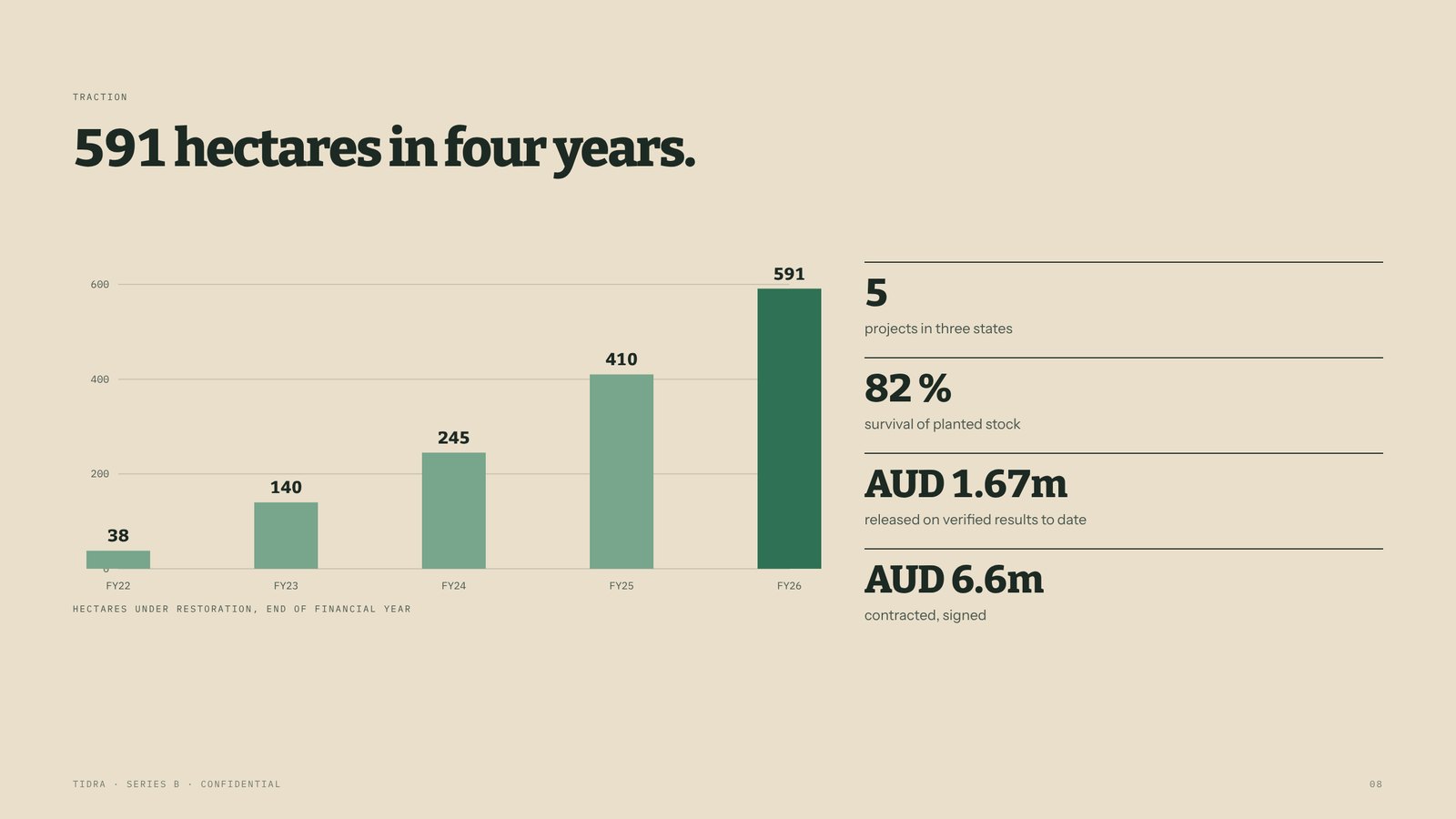
Raise AUD 18 million to reach 2,500 hectares by 2028.
One number per slide, and every number is also in the report.
Three one-page sheets for the three buyers who pay for coastal protection. Same structure and same system; what changes is the photo, the coast drawn in the footer and the argument.
Business development, after a first meeting.
Leave one page that answers the buyer's own question.
Each sheet starts from the buyer's risk, not from tidra's method.
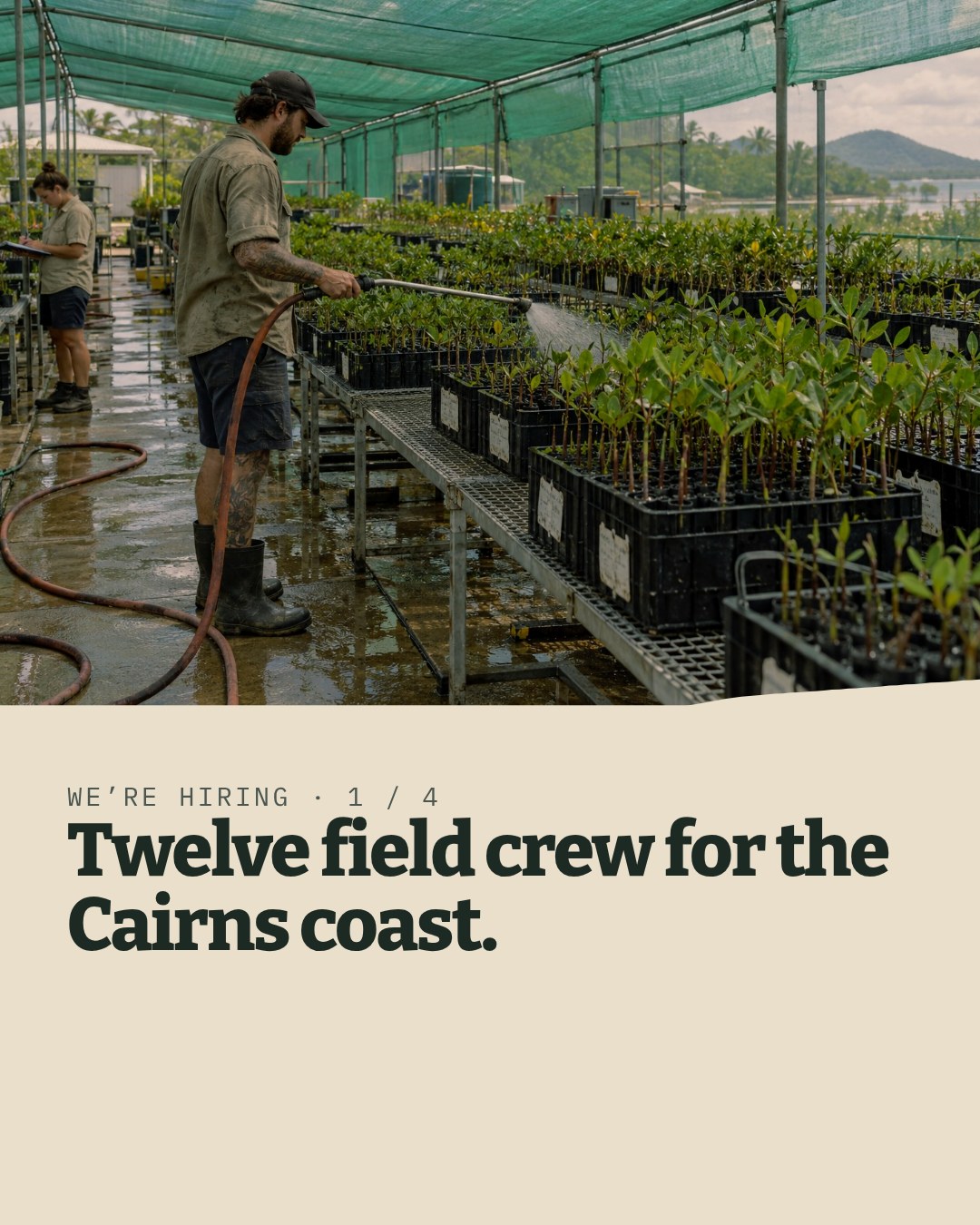
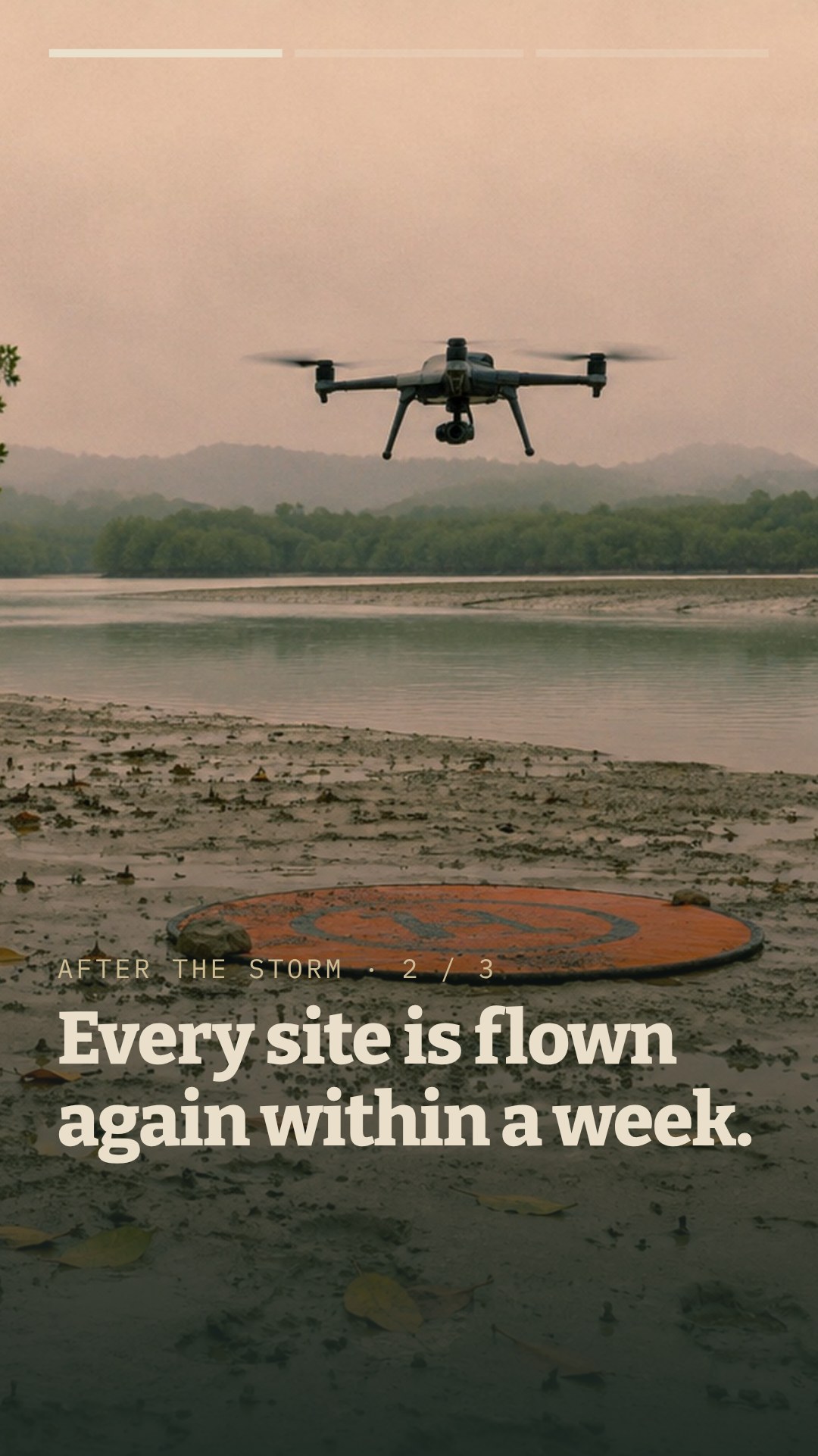
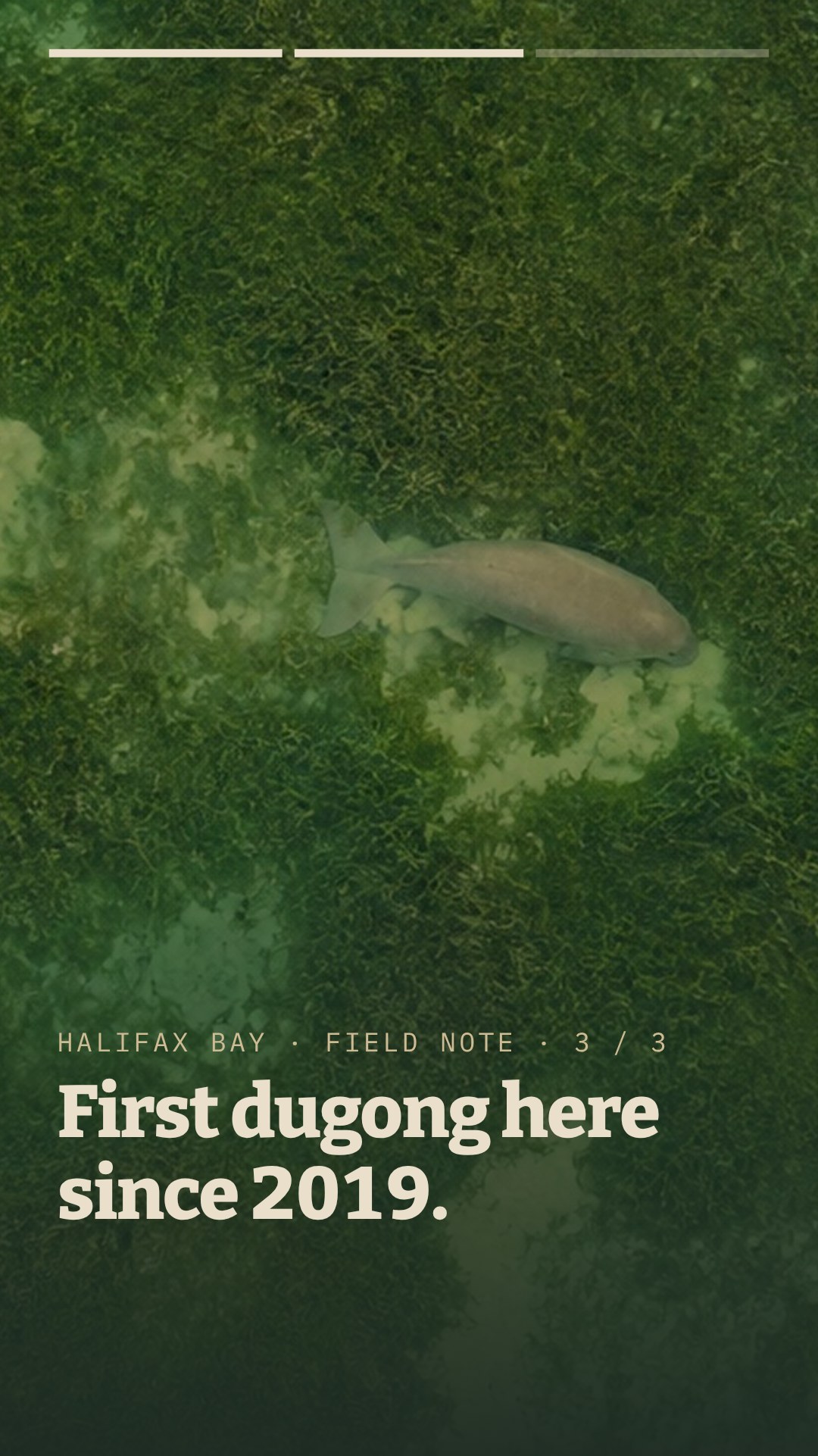
Where most people meet tidra first, and where the proof has to be quickest to read: one photo, one number or one coast per frame, in the same voice as the report.
Neighbours, future crew and the curious.
Show the work every week, in the same voice as the report.
No stock, no sunsets, no slogans. A photo, a number or a coast.
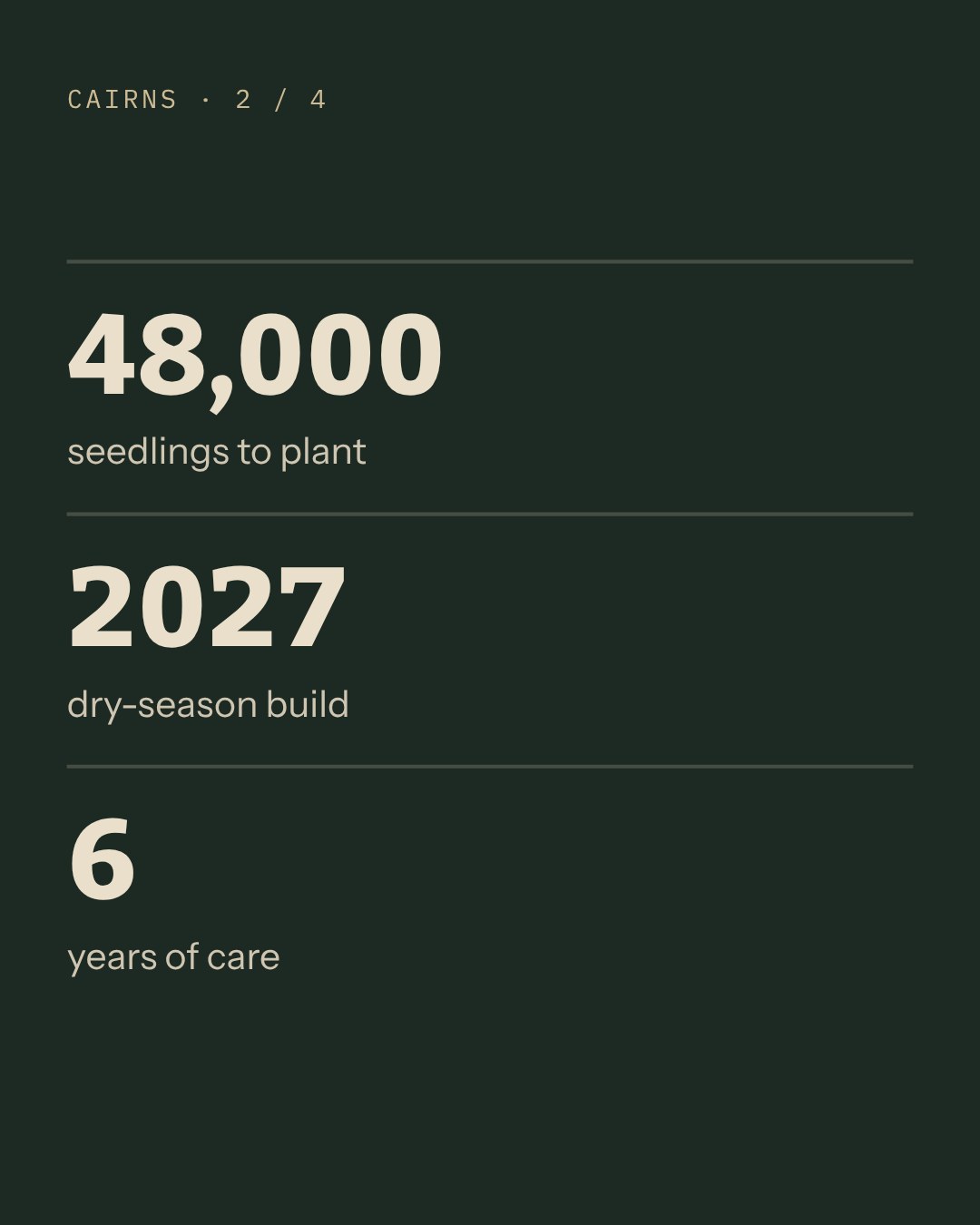
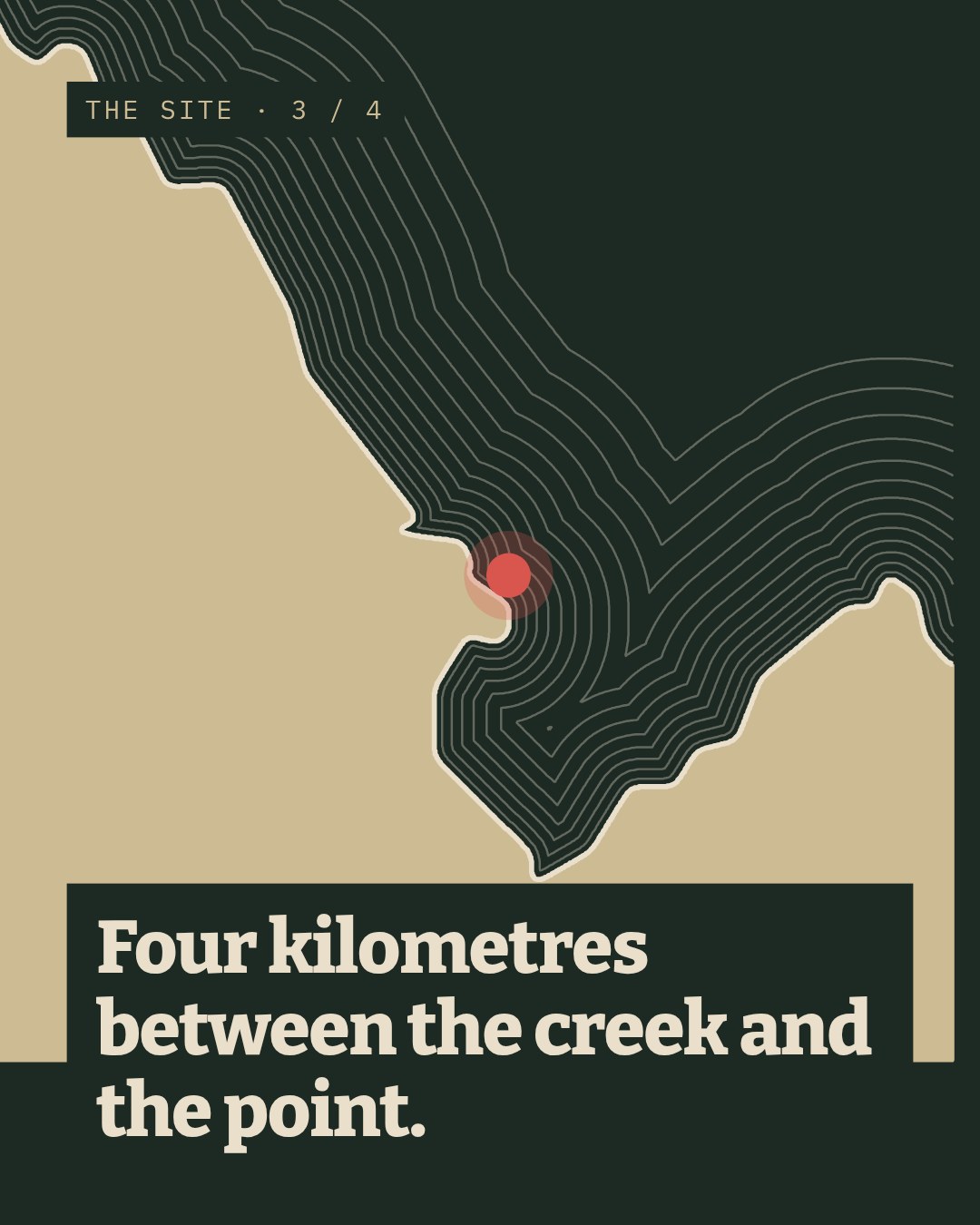
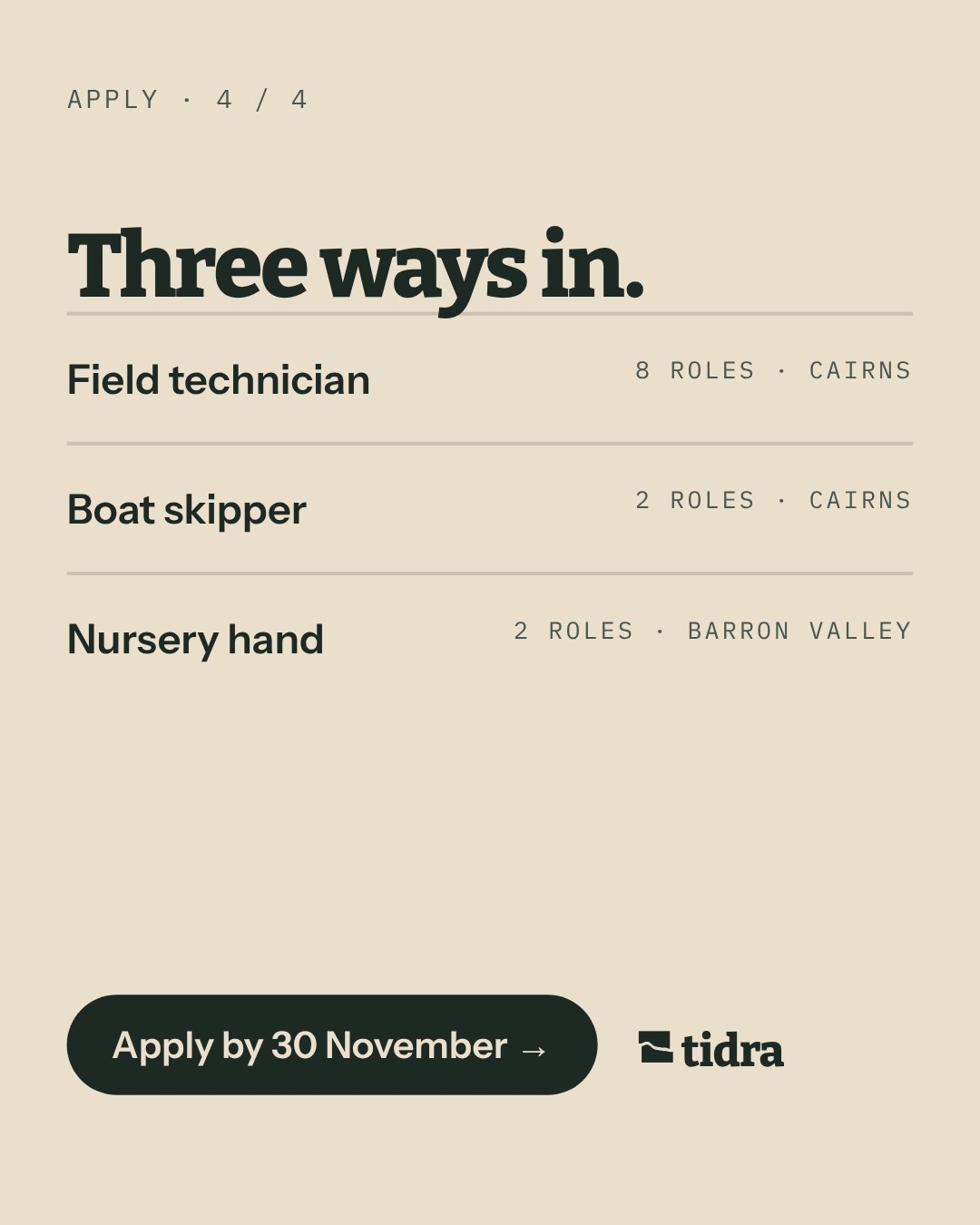
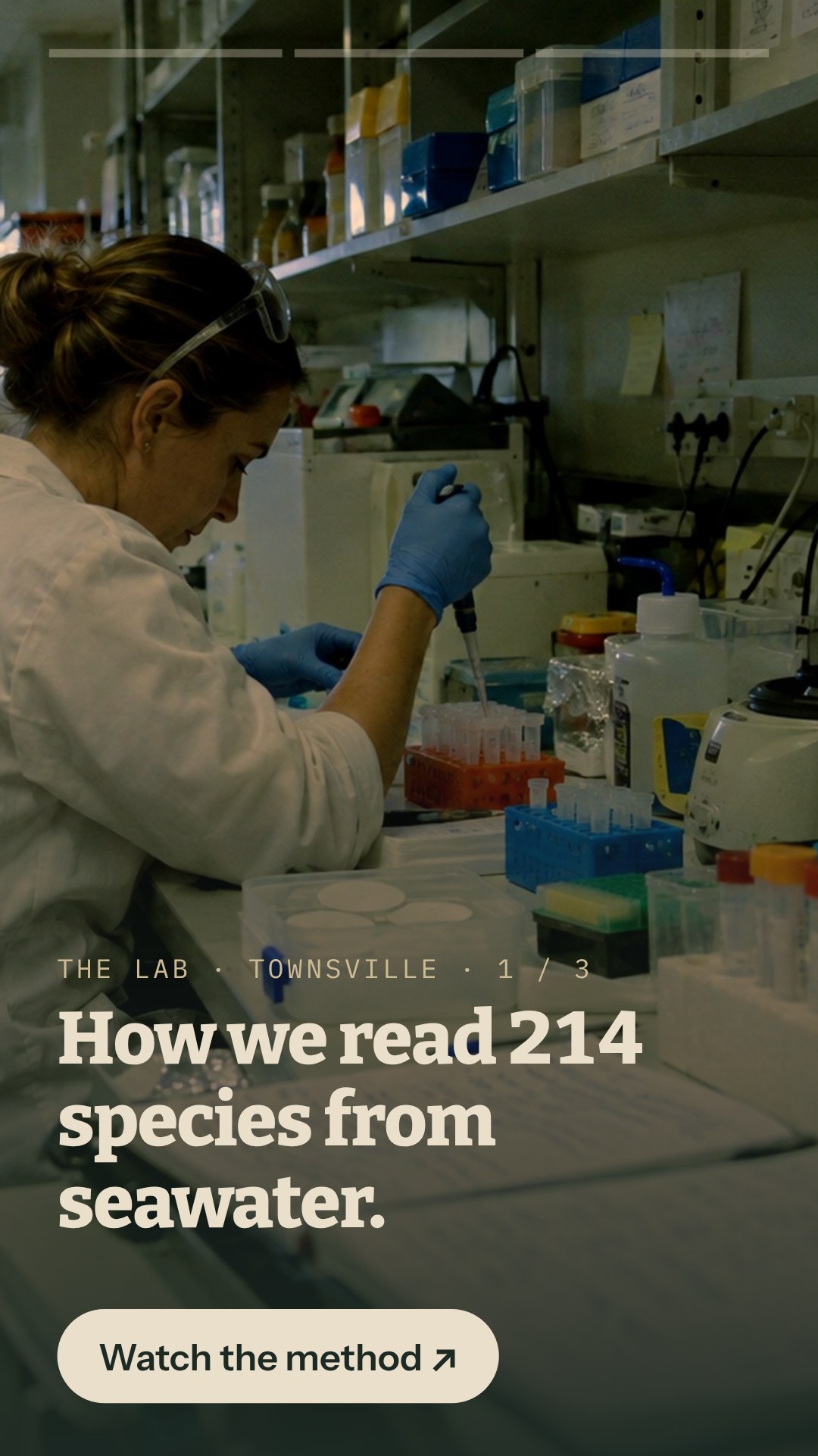
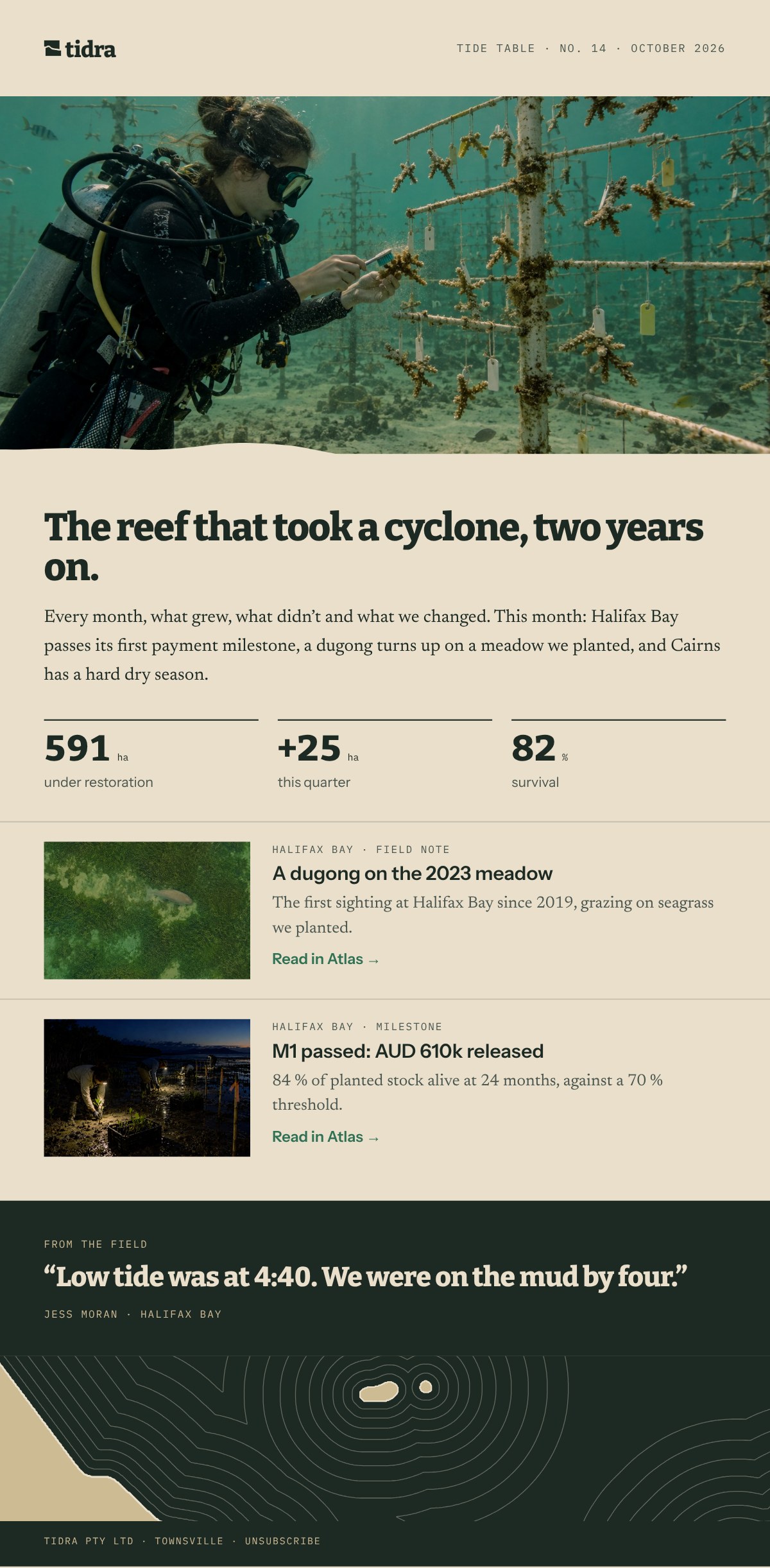
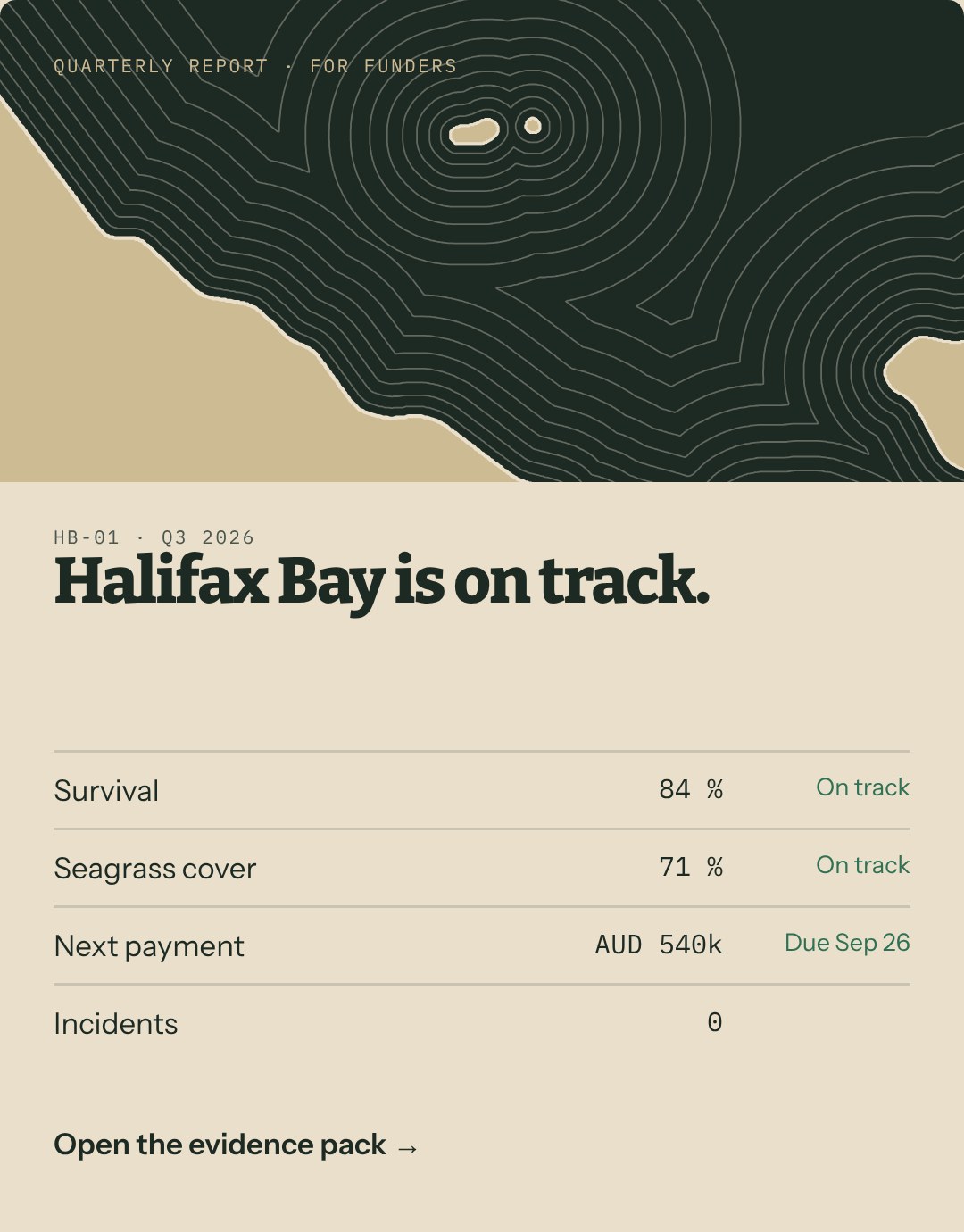
Tide Table has a fixed shape: one story from the field, the month's numbers from Atlas and one honest note about what went wrong. Funder updates come straight from the Ledger, so the numbers in the inbox are the numbers in the contract.
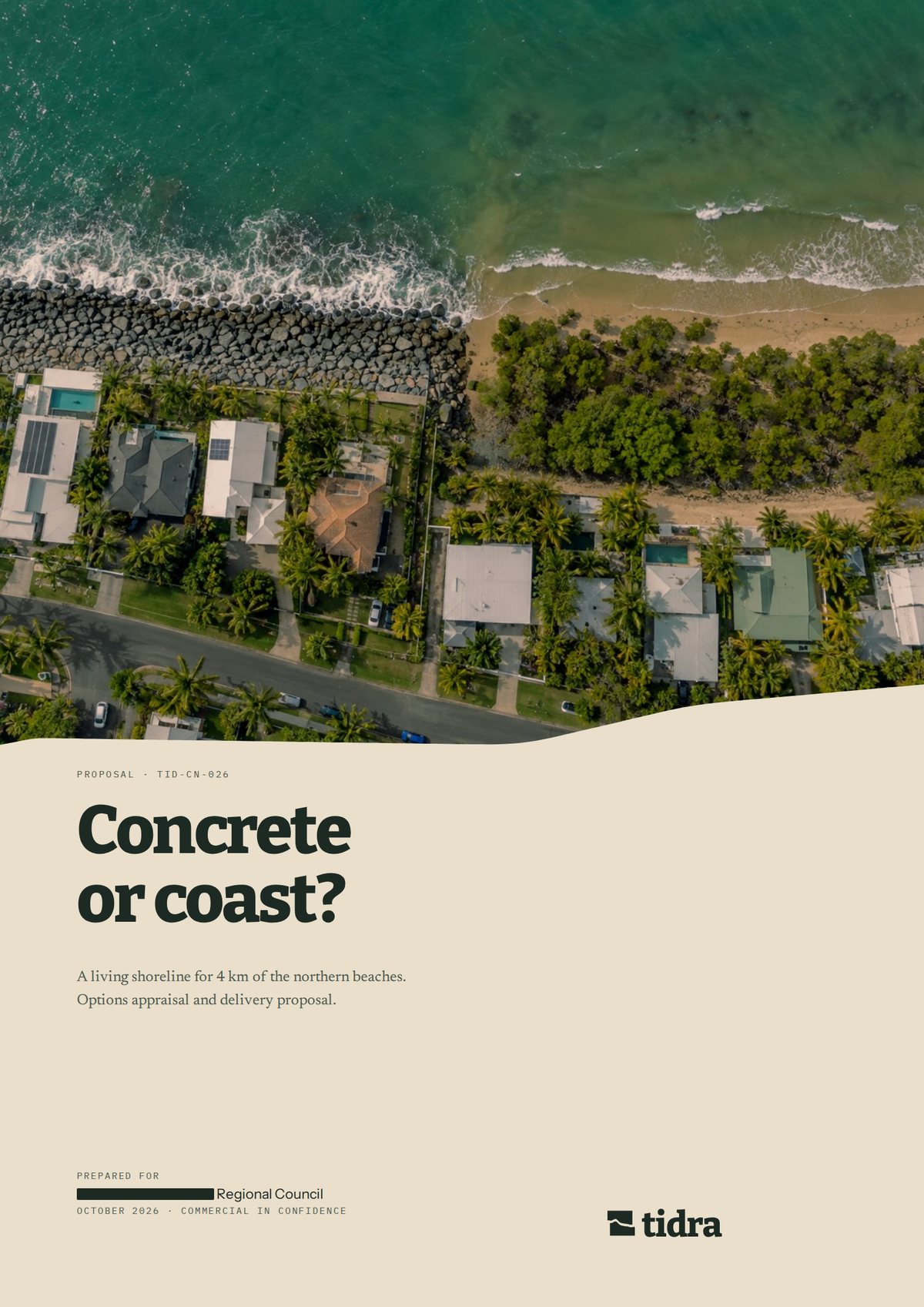
The reef doesn't sign contracts. Councils do.
A proposal to a regional council choosing between a new seawall and a living coast. It answers the council's questions in the council's order, and lets their engineers test every number in Options before they vote.
Councillors, their coastal engineers and the finance team.
Win a AUD 9.2 million contract against concrete.
Page six asks: does the answer change if we are wrong?
Ten days before the vote, the same argument went out onto the street.
05 In the world ↓Out where the work is.
Most of tidra's work happens outside: on a road verge, on a mudflat, on a boat at five in the morning. The system has to survive salt, rain and a glance from a passing car.
Ten days before the council voted, the proposal's own numbers went out onto the street. One photo of the same coast, split down the middle: the wall on one side, the living shoreline on the other, and the price of each. The only time the system lets coral take a whole surface.
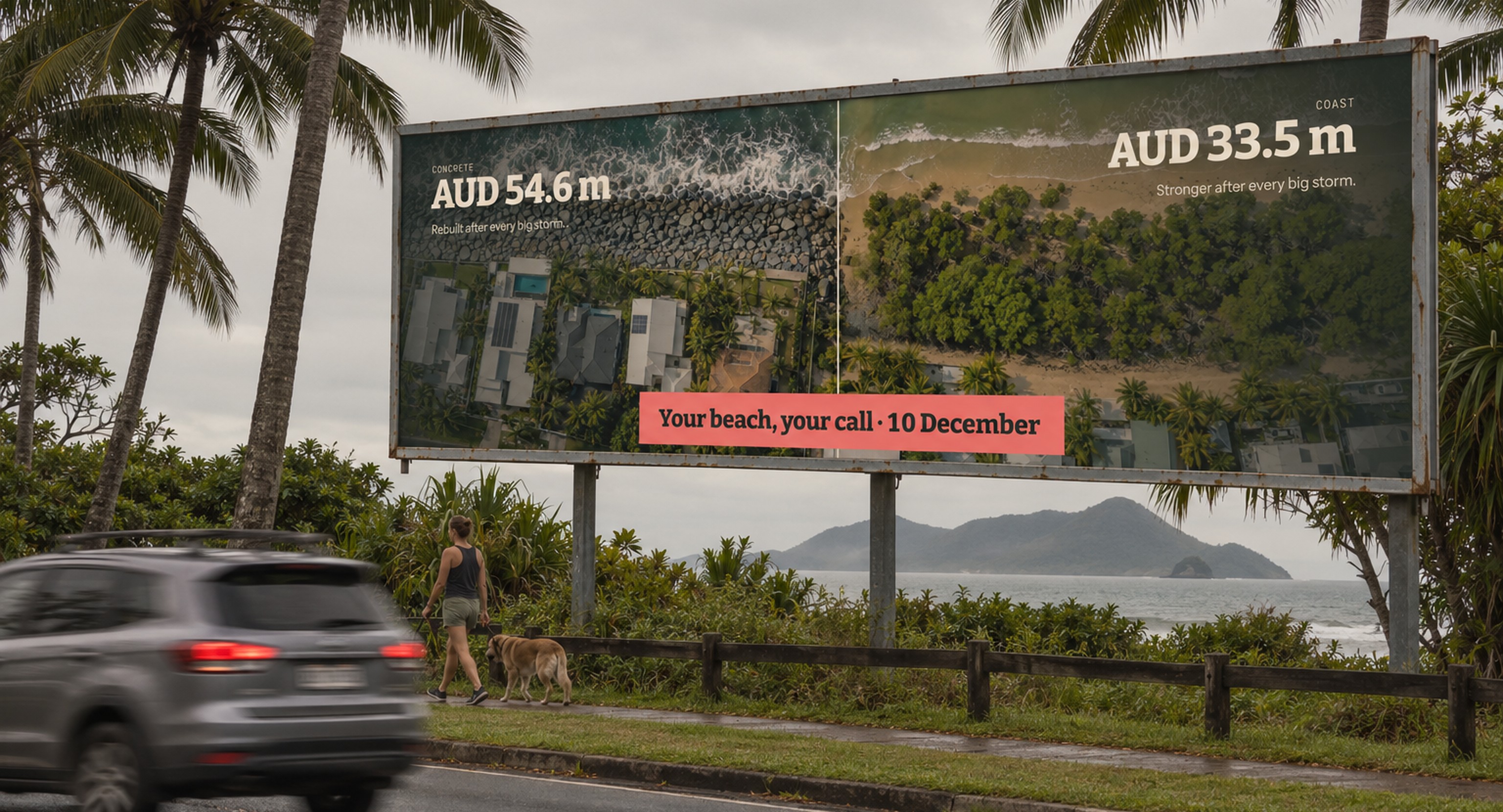
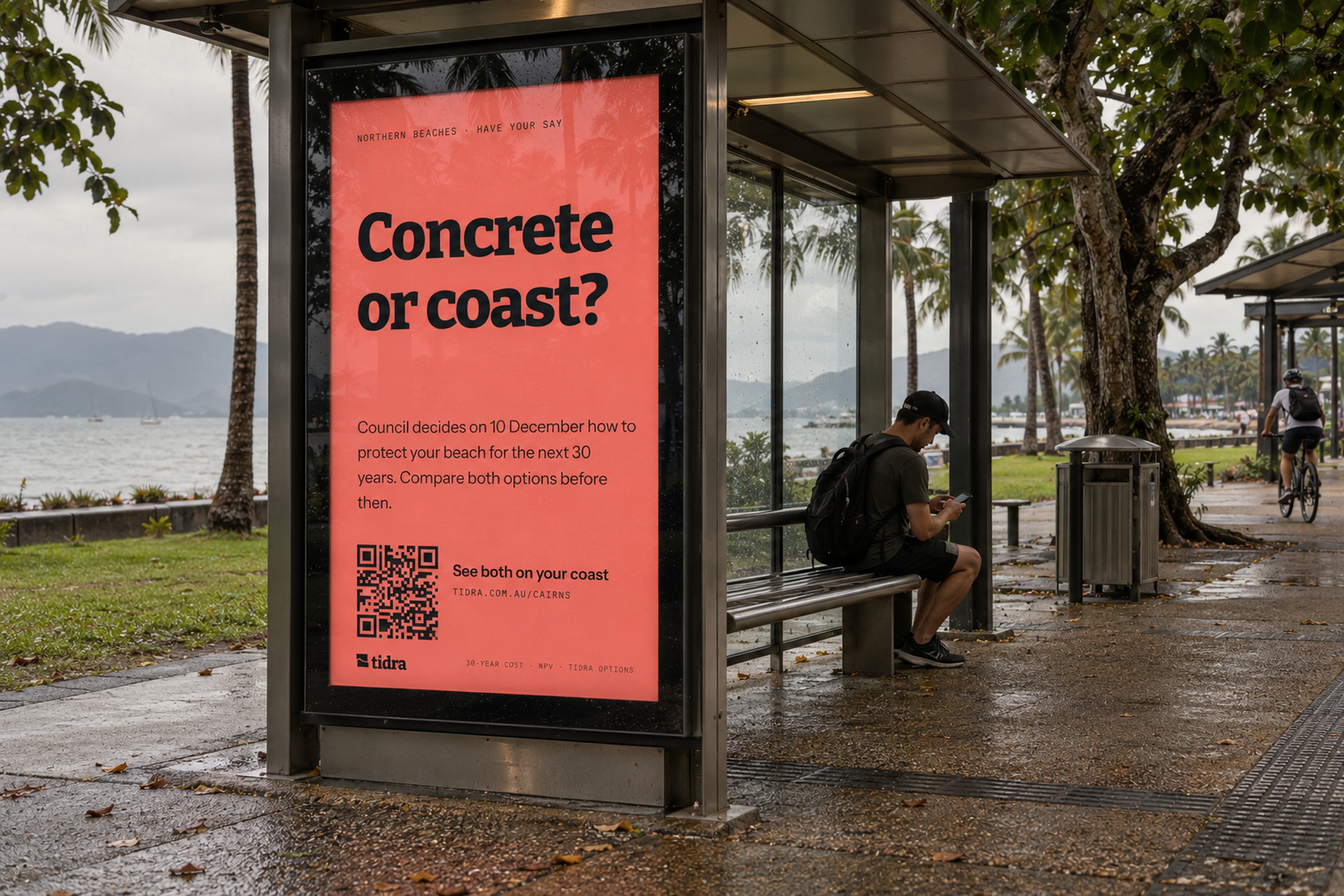
A set of three along the Esplanade: the wall, the coast, and the question. Each poster works alone; walk past all three and the argument is complete.
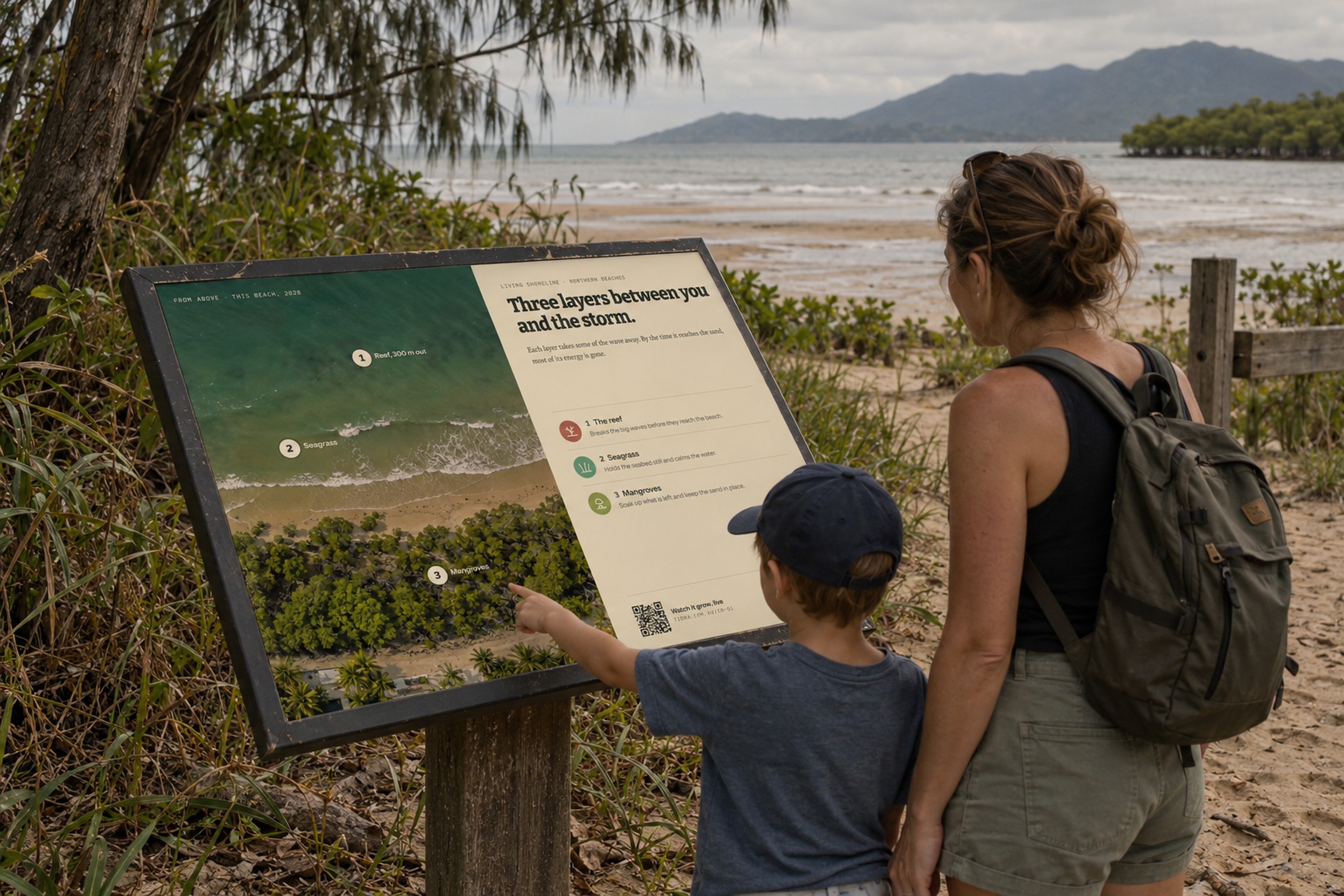
Every site gets a sign that says what is being built, how it is going and where to watch it live. On the beach, a panel explains the three layers of a living shoreline with a photo of that same beach from above.
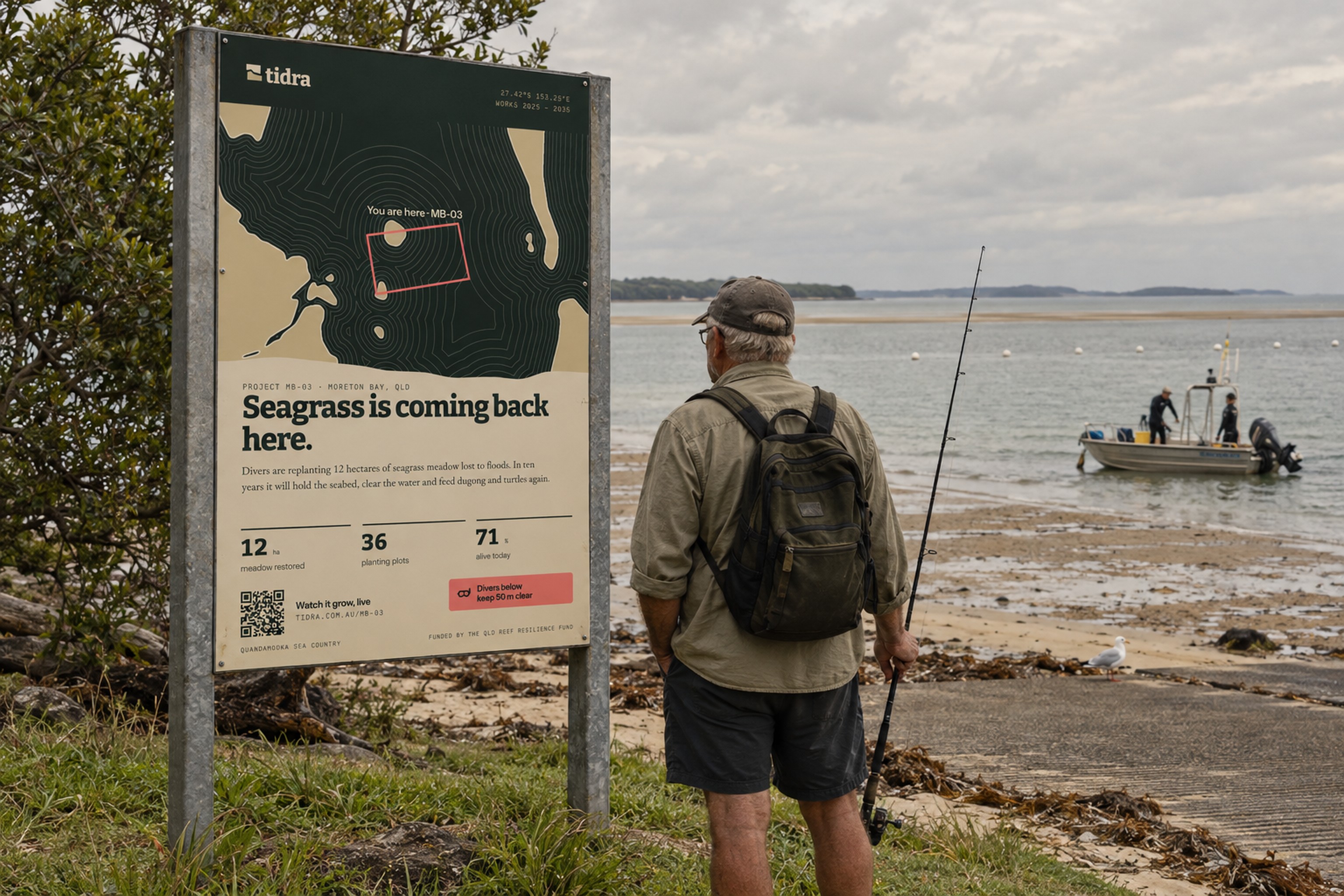
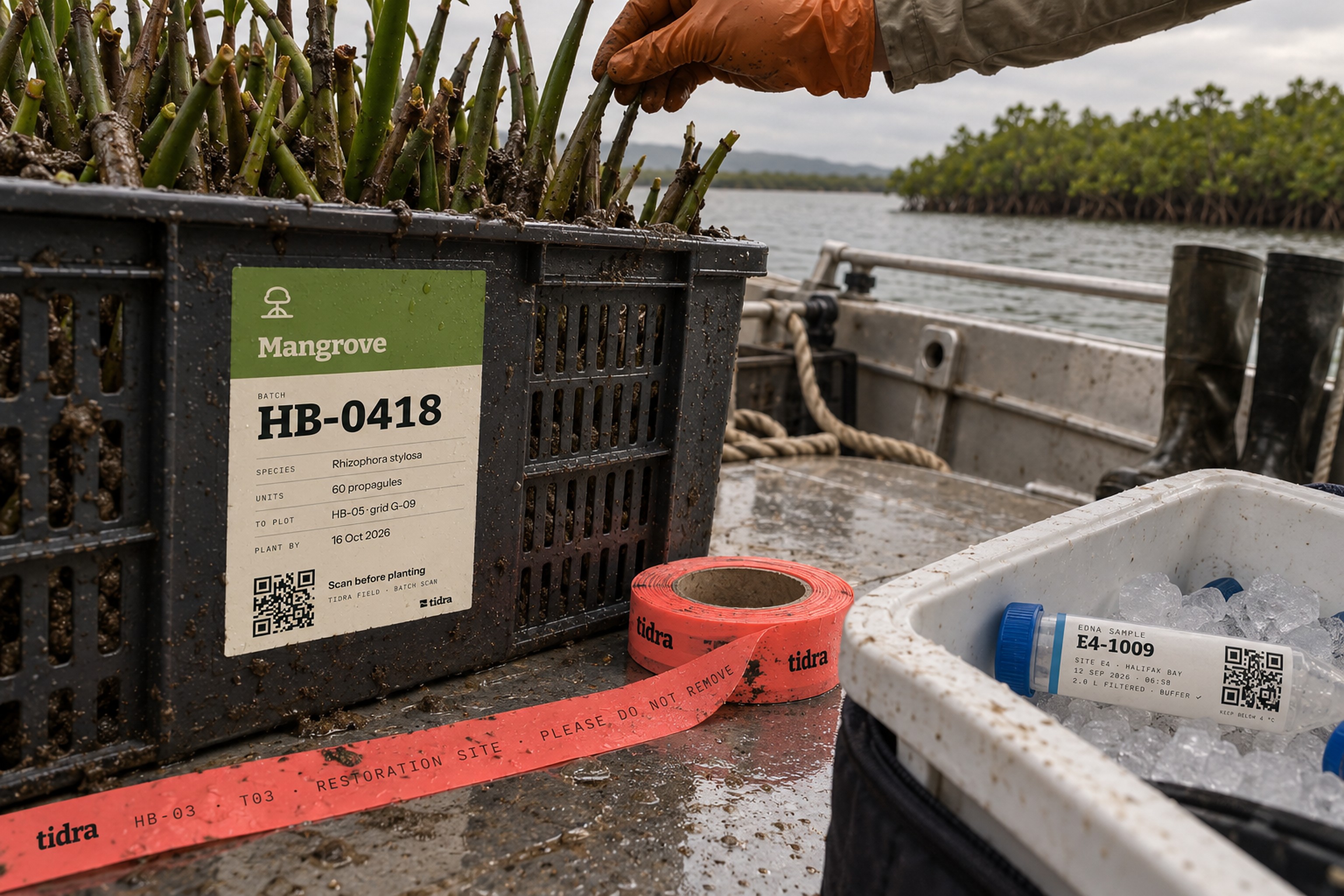
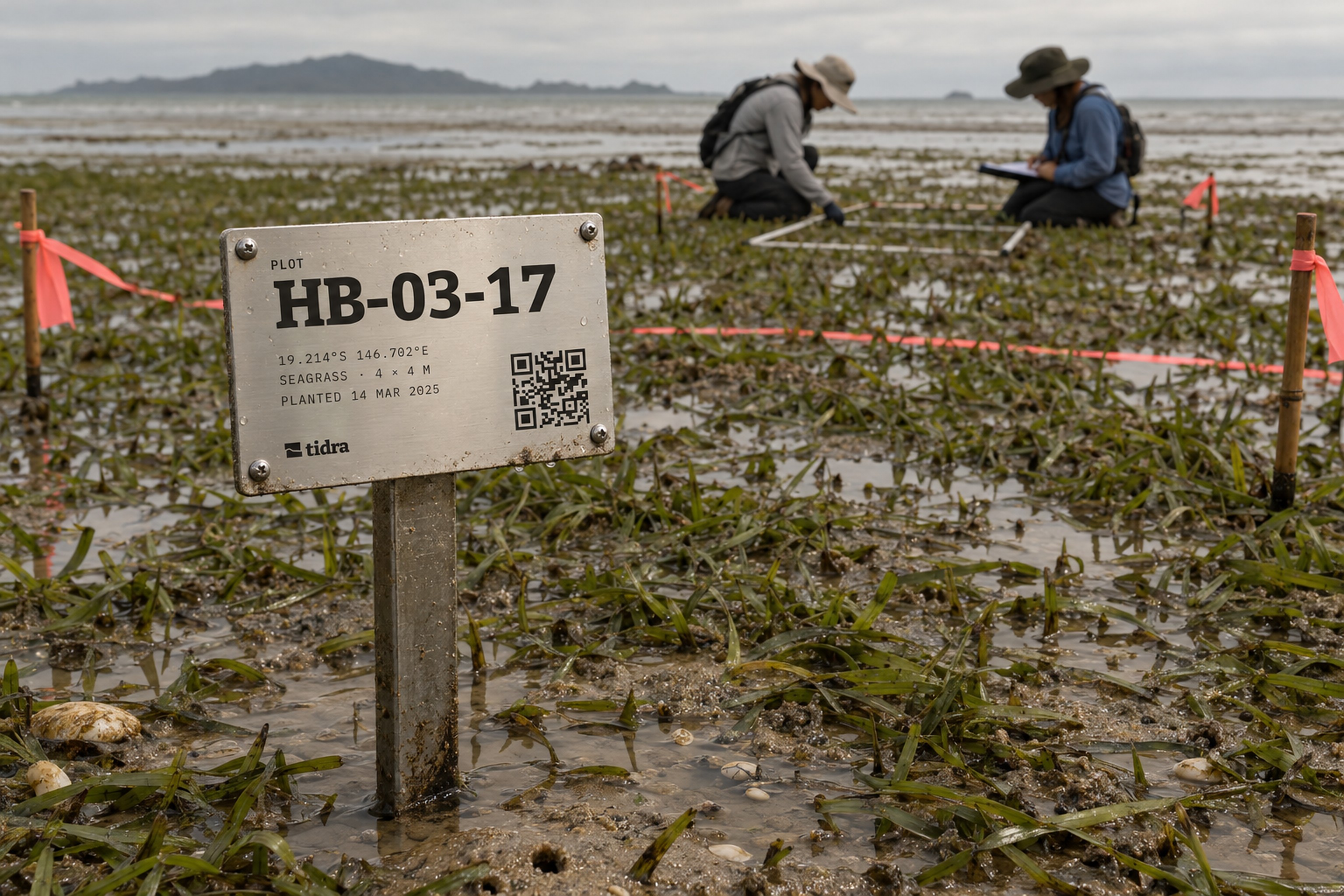
Every object in the field carries its ID. A crate, a sample tube and a plot stake can all be scanned in Field, so each plant is linked to a place, a date and, later, a payment. The type stays readable with wet gloves at arm's length.
The coastline runs the whole length of the hull, so a Tidra boat is recognisable from the shore before anyone can read the name.
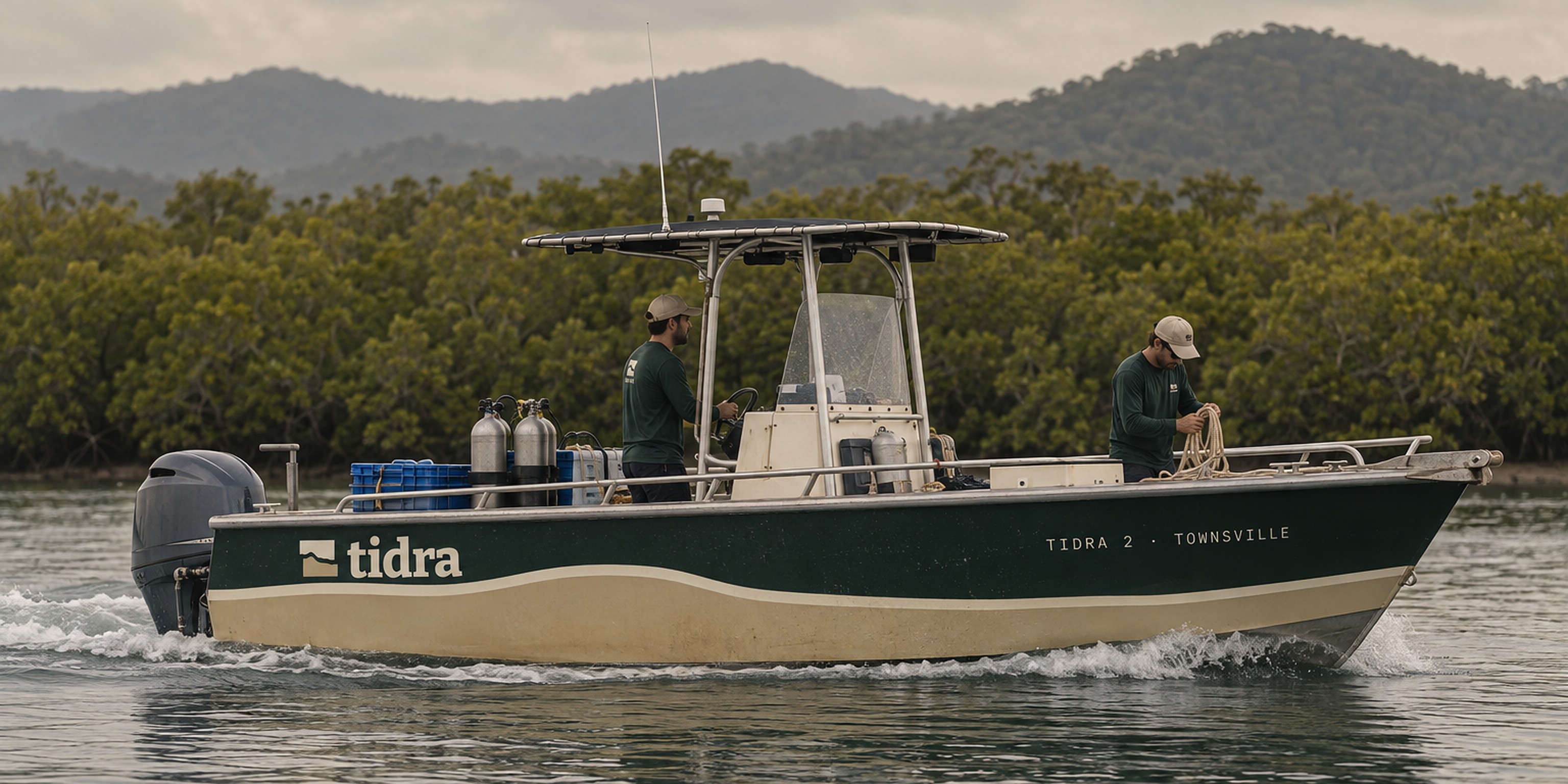
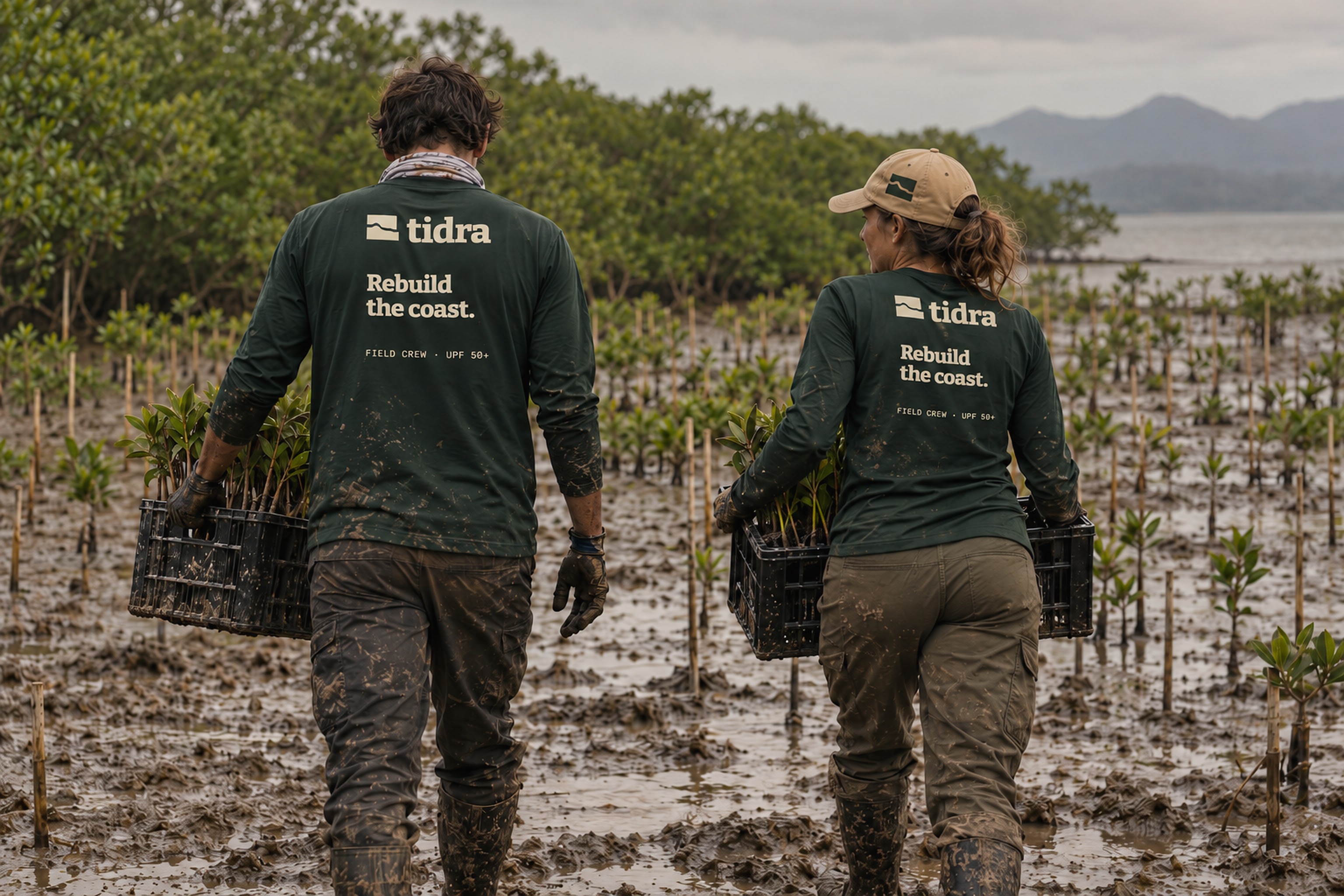
Crew wear brand green: it hides mud and reads well against the mangroves in every field photo. The wordmark goes on the back; on the front and on the cap, the symbol is enough.
At conferences, Tidra doesn't hand out brochures. The screen runs Options: a councillor picks their own beach and sees the wall against the coast in two minutes.
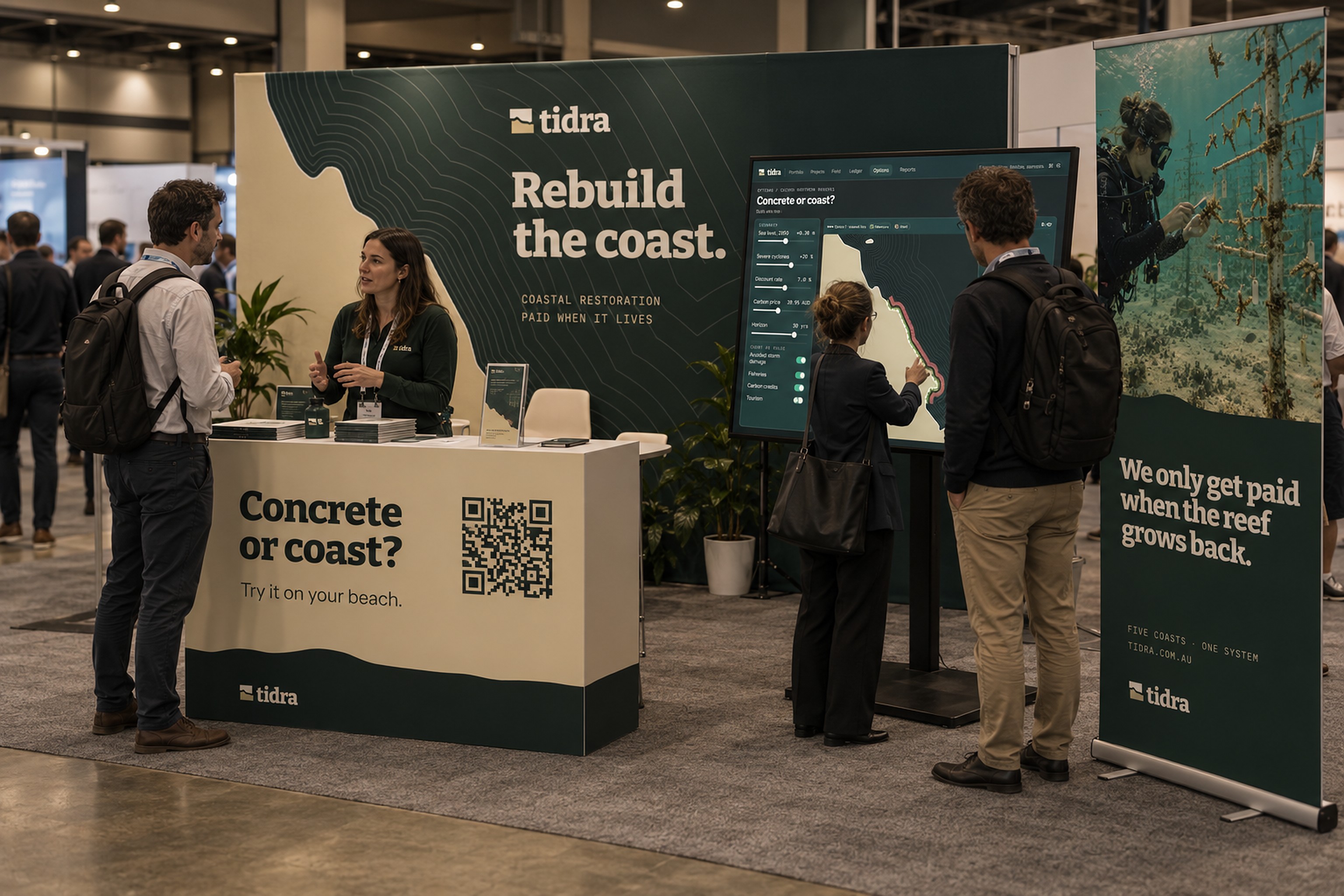
The backwall is one large living-lines map of Cairns, the coast the council was deciding on. Staff wear the field shirt, not a suit.
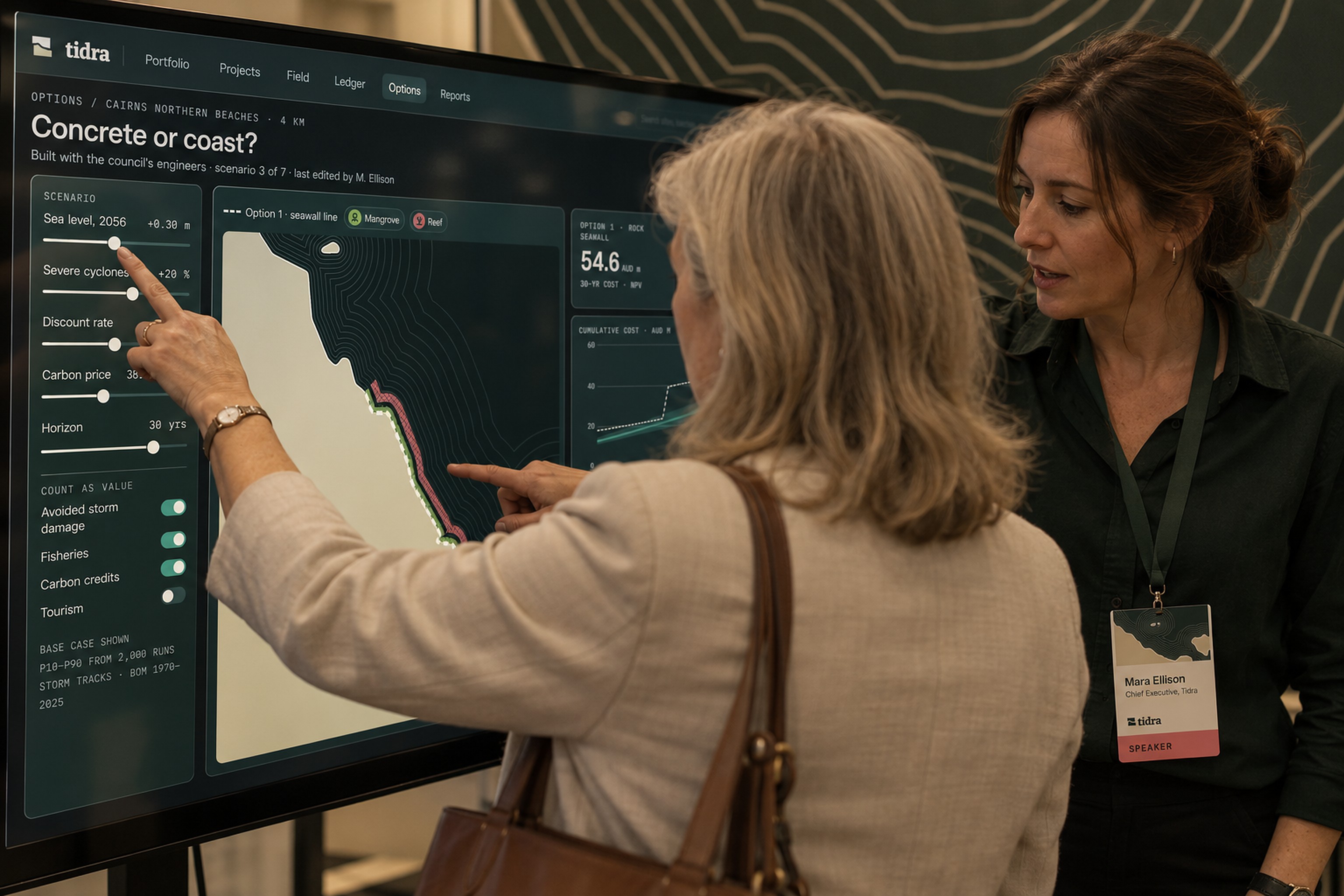
Built to be checked, not believed.
Tidra began with a hard sell: a living coast, offered to people who buy concrete. The answer is a system where every piece carries its own proof. The same living lines and the same numbers run from the tag on a crate of mangroves to a council proposal and an investor report. It was built so that field crews, the product team and a council's engineers can keep making things with it, without me in the room.